Advertisements
Advertisements
Question
Identify instances of ironical comment in the story.
Advertisements
Solution
It is ironical that despite being brutally beaten by Pappachi, Mammachi used to love him. She cried bitterly on his death. However, the fact is that Mammachi was not in love but was used to Pappachi and his beatings.
APPEARS IN
RELATED QUESTIONS
Your school is hosting an Inter-School Quiz Competition.
Write out a notice to be displayed in your school, giving all the details about the event.
Fill in each blank with an appropriate word.
(i) The puppy was hiding ___________ the sofa.
(ii) Stop worrying ______ your future.
(iii) When I stepped ________ the lift, I found it had stopped working.
(iv) We had to use a bridge to go ______ the river.
(v) I have lived in this town ______ ten years.
(vi) Please switch __________ all lights and fans when you leave the room.
(vii) Ronnie is married ______ my cousin.
(viii) The gift came _______ a birthday card.
Why does the poet use repletion in the poem?
What rhyme scheme is followed in the poem?
Research the Battle of Blenheim. Then write an essay defending Wilhelmine’s position that the battle was a “wicked thing” or Kaspar’s position that it was a | “great victory.”
Who was Beatrix Potter?
How can the heart dance?
Why does the caged bird stand on the “grave of dreams?”
There's nobody on the house-tops now...
Just a palsied few at the windows set;
For the best of the sight is, all allow,
At the Shambles' Gate-or, better yet,
By the very scaffold's foot, I trow.
Read the above lines and answer the question that follow.
Why does Browning say that the palsied watched the execution?
How does Seattle justify his religion as opposed to what the white men had said about it?
How does the story “A Horse and Two Goats” develop the idea of the need to interact with people who have vastly different identities from your own?
Every family has a black sheep. (Begin: There is no ………….)
Anil is too fast a runner not to come first in the race. (Begin: Anil is so………….)
As soon as the sports meet ended, the children ran on the field. (Begin: Hardly ……………)
Write a composition (350 - 400 words) on the following:
Narrate an incident from your own experience when you expected to do very well, but for some reason were unable to do so. Explain what happened and why it happened. What lesson did you learn from it?
Referring closely to the essay On Going on a Journey, give Hazlitt's views about the manner in which a change of place brings about a.change in ideas, opinions, and feelings.
Fill in the blank with an appropriate word:
The paper dart went gliding ______ the air.
Re-write the following sentence according to the instruction given. Make other changes that may be necessary, but do not change the meaning of the sentence.
As soon as Sania sat down to study, the lights went off.
(Begin: No sooner……….)
We have had to respect for nature. Now we are suffering from the effects of global warming.
Which local bird is like the goldfinch.
Notice the following sentence patterns.
And who art thou? said I to the soft-falling shower.
Rewrite the above sentences in prose.
How does Mammachi stand out as an independent resilient woman in the text?
Entomologist and lepidopterists are mentioned in the text and you must have guessed the meanings of these words or found them out in the dictionary.
Now match the kinds of scientists given with the work they do:
|
A |
B |
|
ornithologist |
study of the skin |
|
gerontologist |
study of cells |
|
ergonomist |
study of birds |
|
dermatologist |
study of old age |
|
cytologist |
study of the design of equipment |
Interview the students of your class regarding the career they would like to pursue and the reason for selecting that particular career. Collect the data from your class and analyze the information you have collected.
Go to your college library and collect and read the poems written by Sarojini Naidu.
What do you know about Kalpana Chawla’s education? How did she become an American citizen?
The story of Kalpana Chawla has become an inspiration for millions of young Indians. How? What message did she send from the space shuttle to students of her college?
The word ‘round’ usually means a kind of shape. What is its meaning in the story?
Re-word the line from the story:
“We cannot bandage the children’s mouths, so they really have to exercise their will-power.”
The cherry tree is a narrative poem. Features that make it a narrative poem are given below. Justify them with proper examples.
Different places are mentioned.
The cherry tree is a narrative poem. Features that make it a narrative poem are given below. Justify them with proper examples.
It is a time-bound poem.
From the passage, find and write any two examples of the following:
Sentences containing
- 'must'
- 'can'
Discuss the following and write about the following in your own words in 5-6 lines.
What would you do, if something like this happens to you?
Write about the daily routine of the 'Lord of Tartary' in 8-10 lines.
Hold a discussion in the classroom about the differences between printed newspapers, radio news bulletins, TV news bulletins. Discuss the merits, demerits, and popularity of each.
Note that it is possible to feel both kinds of emotions at the same time. Have you experienced it? Try to describe the situation in short.
Discuss the following elements of a detective or mystery story.
- a mystery
- strange happenings
- a smart detective who investigates the happenings
- a crime/possibility of a crime
- preventing the crime and catching the criminal.
- characteristics of the victim
- characteristics of the criminal
- characteristics of the detective
Use the elements to prepare outlines of detective stories using your imagination. Write a story using any one of the outlines.
Write the reason in your own words.
Ostad’s song was more elating than Tansen’s songs.
Discuss with your friend/brother/sister/your classmate and write your list of wishes to make your village/town/city people happy.
You can use the following words.
- great
- wish
- share
- talk
- help
- cooperate
- communicate
Prepare a set of questions to interview:
a person who has recently scaled Mt. Everest.
Write a report of the following event in about 100-120 words.
You are the School Pupil Leader. You have been asked to write a report on the Inaugural Ceremony of English Literary Association of your school which was held recently. Write a report on the same in not more than 120 words.
Write a paragraph of 100 – 120 words about a memorable anecdote/incident of your life.
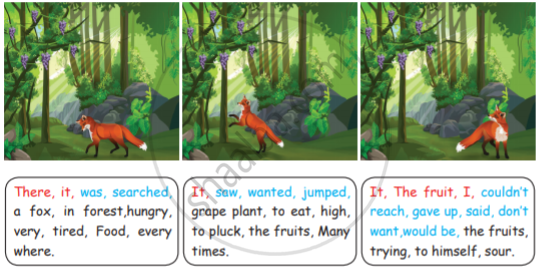
Write the hungry fox story on your own by looking at the pictures and using the clues given under each picture.
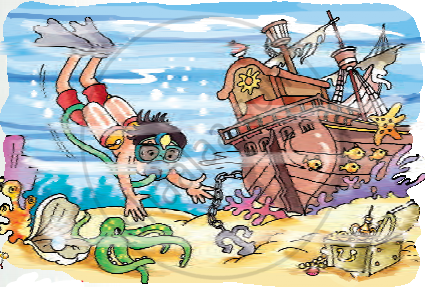
Work in groups of four. See the picture of a shipwreck at the bottom of the ocean.
Suppose you went deep-sea diving. What would you find? Think of all the words that come to your mind, then build a paragraph. Share your story with other groups.
Find out the following from ten families living in your neighbourhood.
| Count the number of F1* F2 F3 F4 F5 F6 F7 F8 F9 F10 Total |
| children below 5 years of age |
| children from 5-14 years |
| grown-up children from 15-20 |
| elders from 21-50 years |
| old people who are above 50 years |
| total number of people in the family |
*F = Family
- How many members are educated in each family?
- From amongst the ten families, how many are educated?
Now talk to your partner and then write a report about your neighbourhood.
Given a chance, any adult would wish to become a child again for many reasons. Fill the boxes with some of what you imagine could be the reasons.
| e.g. I need not worry about project deadlines. | |||
| I can wear my pajamas the whole day. | |||
| I can sleep as long as I like. |
What do you expect your close friends to do for you? Beautify the petals with your thoughts.

When and how did Bob realise that the tall man was not his friend?
What would you do in this situation, if you were Jimmy Wells? Substantiate your reason.
What made her feel confident about the competitive players? Explain.
Why did K.C’s words shock Sletherby?
Write conversation on the following situation.
Between two friends on an exciting cricket match
The photograph did not look like ______.
The Government of Tamil Nadu has imposed a ban on the use of plastic. Effective implementation of this ban depends on public awareness and individual responsibility.
Write an article of 150 words for your school magazine to create an awareness of the dangers posed by indiscriminate use of plastic. Expand the ideas given below as notes.
Notes:
a. Introduction
(i) Plastic – synthetic material – doesn’t decompose in soil
(ii) Inevitable role of plastic – man’s day-to-day life
b. Human Health Hazard
(i) Leeching of plastic into food – micro plastic entering food chain
(ii) Human body’s inability to deal with this unnatural substance
(iii) Reaction of microplastic in human body and ill effects
c. Adverse Effects on Plants and Animals
(i) Plastic particles choking waterways – affect aquatic animals
(ii) Ingestion by aquatic and terrestrial animals–blocking of intestines and respiratory passages
d. Environmental Degradation
(i) Manufacturing process and burning of plastics–pollute atmosphere
(ii) Plastic–non-biodegradable – interferes with soil microorganisms – affects soil fertility
e. Conclusion
(i) Suggestions for restricted use – alternatives for one-time use of plastics
(ii) Segregation of plastic waste – for recycling
You have been given a small sum of money to buy a gift with for a friend. What gift would you choose (specify) and why would you choose this? Write a letter to your friend telling him/her about the gift and how it will benefit him/her.
Work in groups and prepare an attractive wrapper or packet for any product of your choice. Prepare an advertisement for your product.
What makes you angry?
Using the given informal letter as a model, write a letter about the topic given below.
Write a letter to your father asking permission to go on an educational tour.
As a Member of the Student Council of ABC School, you wish to start a Laughter Club to develop the appreciation for humour among students. Write a proposal in not more than 150 words, outlining the steps you would take to make this club a success.
Read the passage given below and answer the questions (i), (ii) and (iii) that follow.
| (1) | “Can I see the Manager?” I said, and added solemnly, “Alone.” I don't know why I said “Alone.” “Certainly,” said the accountant and fetched him. | |
| (2) | The Manager was a grave, calm man. I held my fifty-six dollars clutched in a crumpled ball in my pocket. “Are you the Manager?” I asked. God knows I did not doubt it. “Yes,” he said. “Can I see you …. alone?” I asked. |
5 |
| (3) | The Manager looked at me in some alarm. He felt that I had an awful secret to reveal. “Come in here,” he said, and led the way to a private room. He turned the key in the lock. “We are safe from interruption here,” he said; “Sit down.” We both sat down and looked at each other. I found no voice to speak. “You are one of Pinkerton’s men, I presume,” he said. |
10 |
| (4) |
He had gathered from my mysterious manner that I was a detective. I knew what he was thinking, and it made me worse. |
15
20
|
| (5) | The Manager got up and opened the door. He called to the accountant. “Mr. Montgomery,” he said unkindly loud, “this gentleman is opening an account, he will deposit fifty-six dollars. Good morning.” I rose. A big iron door stood open at the side of the room. “Good morning,” I said, and stepped into the safe. “Come out,” said the Manager coldly and showed me the other way. |
30 |
| (6) | I went up to the accountant’s wicket and poked the ball of money at him with a quick convulsive movement as if I were doing a conjuring trick. My face was ghastly pale. “Here,” I said, “deposit it.” The tone of the words seemed to mean, “Let us do this painful thing while the fit is on us.” He took the money and gave it to another clerk. |
35 |
| (7) | He made me write the sum on a slip and sign my name in a book. I no longer knew what I was doing. The bank swam before my eyes. “Is it deposited?” I asked in a hollow, vibrating voice. “It is,” said the accountant. “Then I want to draw a cheque.” My idea was to draw out six dollars of it for present use. Someone gave me a chequebook through a wicket and someone else began telling me how to write it out. The people in the bank had the impression that I was an invalid millionaire. I wrote something on the cheque and thrust it in at the clerk. He looked at it. |
40
45 |
| (8) | “What! Are you drawing it all out again?” he asked in surprise. Then I realised that I had written fifty-six instead of six. I was too far gone to reason now. I had a feeling that it was impossible to explain the thing. I had burned my boats. All the clerks had stopped writing to look at me. Reckless with misery, I made a plunge. “Yes, the whole thing.” “You withdraw all your money from the bank?” “Every cent of it.” “Are you not going to deposit anymore?” said the clerk, astonished. “Never.” |
50
55 |
| (9) | An idiot hope struck me that they might think something had insulted me while I was writing the cheque and that I had changed my mind. I made a wretched attempt to look like a man with a fearfully quick temper. | |
| (10) | The clerk prepared to pay the money. “How will you have it?” he said. This question came as a bolt from the blue. “What?” “How will you have it?” “Oh!”— I caught his meaning and answered without even trying to think— “in fifties.” He gave me a fifty-dollar bill. “And the six?” he asked dryly. “In sixes,” I said. He gave it to me and I rushed out. As the big door swung behind me. I caught the echo of a roar of laughter that went up to the ceiling of the bank. Since then, I bank no more. I keep my money in cash in my trousers pocket and my savings in silver dollars in a sock. |
60
65
70 |
| Adapted from: My Financial Career By Stephen Leacock |
||
-
- Find a single word from the passage that will exactly replace the underlined word or words in the following sentences. [3]
- The kind stranger went and got back the ball from where it had rolled into the bush.
- I took offence at the expression on his face that was clearly meant to insinuate I was a liar.
- The firm experienced a financial loss when the contract went to a contender who had just entered the business.
- For each of the words given below, choose the correct sentence that uses the same word unchanged in spelling, but with a different meaning from that which it carries in the passage. [3]
- alarm (line 8)
- The silence from the other end set off alarm bells in her head.
- The pallor of his skin alarmed those standing around.
- I set my alarm for six o’clock but slept through it.
- The sound of the approaching jets caused some alarm in the war room.
- wicket (line 44)
- The wicketkeeper was the true saviour of the day for that one match.
- The team wanted to bat while the wicket was still dry.
- The man at the window handed us our tickets through the wicket.
- The quick loss of wickets demoralised the team.
- reason (line 48)
- After the tragedy, his ability to reason is severely diminished.
- They reasoned they could get better seats if they arrived early.
- Recipients of funds were selected without rhyme or reason.
- We have every reason to celebrate.
- alarm (line 8)
- Find a single word from the passage that will exactly replace the underlined word or words in the following sentences. [3]
- Answer the following questions as briefly as possible in your own words.
- With reference to the passage, explain the meaning of the expression of the ‘I had burned my boats?’ [2]
- Cite any two instances of the behaviour of the bank employees that indicate the insignificance of a deposit of fifty-six dollars. [2]
- Why do you think the people in the bank thought of the narrator as an “invalid millionaire?” [2]
- Summarise why the narrator decided ‘to bank no more’ (paragraphs 6 to 10). You are required to write the summary in the form of a connected passage in about 100 words. Failure to keep within the word limit will be penalised. [8]
