Advertisements
Advertisements
Question
How did Woman 5 spend her time in the waiting hall?
Advertisements
Solution
Woman 5 spent her time by showing her photos to some of the patients. She went on describing the place when the photo was taken. She explained the persons found in the photos and about their qualities and facilities.
APPEARS IN
RELATED QUESTIONS
Define the following terms from the poem: rivulet, plough share (plowshare), yon, and childing.
What are the fears of the caged bird? Answer with examples from Maya Angelou’s poem.
Comment on the imagery used in the poem.
What is the conflict and twist to the short story “Heart and Hands”?
The end justifies the means.' Argue for or against the statement.
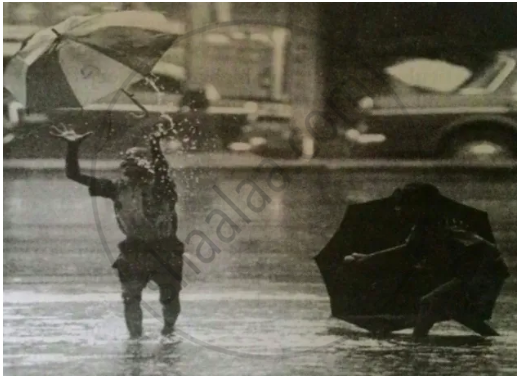
Study the picture given below. Write a story or a description or an account of what it suggests to you. Your composition may be about the subject of the picture or you may take suggestions from it; however, there must be a clear connection between the picture and your composition.
Write a composition (350 – 400 words) on the following:
Write an original story that begins with the words : “He was the funniest boy I had ever met. He would make everyone laugh………”
Why is the image of the engine evoked by the poet?
Discuss the manner in which the author interweaves details of the narrator’s family with the flow of the main narrative.
Make a paraphrase of the poem ‘Leisure’ in your own simple words. Write it down in your notebook.
Give suggestions to protect our national heritage monuments.
Use the details given in the story and your imagination and prepare a timetable for the trip to the moon.
Relate the life-story of Caesar, rearranging the facts in a proper sequence in the form of a flow chart:
- Caesar begins to upset things at home
- Neighbour flings a stick at Caesar
- Young crow is saved by the narrator
- Caesar begins to trouble neighbours
- The crow is named Caesar
- Caesar passes away
- Caesar objects to being caged.
Hold a discussion in the classroom about the differences between printed newspapers, radio news bulletins, TV news bulletins. Discuss the merits, demerits, and popularity of each.
Say ‘WHY’?
The writer claims that all false beliefs need not be replaced by cold science.
Write a short essay on the following.
What I would like to do for my country.
Among your classmates, one is unable to walk properly, the second one can’t hear properly and the third one can’t see this beautiful world. All of them are facing lots of difficulties in life. Compose a dialogue among them, about the problems and difficulties faced by them. You can take help of the following dialogue to expand your ideas.
| Student 1: | Do you know, how many problems I have to face when I decide to go anywhere? |
| Student 2: | I can’t hear anything. |
| Student 3: | So, sad! You both can’t walk or hear but my problem is more serious than yours. You know, I can’t see this beautiful world. |
(Now continue in your notebook.)
Expand the proverb in about 12 to 15 lines, ‘Where there is a will, there is a way.’
Steps:
- Explanation of the proverb in simple words.
- Examples/Experiences to prove the proverbs.
- Conclusion
You are a volunteer in your locality to serve people who are affected by floods. How will you caution them to move to a safer place taking only their bare necessities? Describe.
Dinesh and Divya have been assigned homework on non-finite. They are not sure when to use a gerund and when to use an infinitive. They decide to meet their teacher and get their doubts cleared. The teacher introduces them to Mr. Gerund and Ms. Infinitive.
Let's write a poem.
I have a kite but need a friend to fly it with,
I know a song but need someone to hear it,
I have a ball but need someone to catch it,
I ______
I ______
I ______
I ______
Rewrite the passage below using capital letters where necessary
oh dear said the fir tree I like my old needle-like leaves best for goats don't eat them and no man can steal them
Find one word from the story that means
to think w ______.
Some word have similar sound, but different meaning. Choose the correct word from the option and fill in the blank.
He is our school ______.
Now describe two of the following processes.
(i) How to send a letter/e-mail.
(ii) How to make a salad.
(iii) How to prepare a garden bed to grow flowers.
(iv) How to paint a mural or a wall picture.
The boys played ______[quiet]
Reading a map
Nowadays though locations are traced easily using GPS, (Global Positioning System) one should know what to look for in the map to reach the destination. Here are a few general instructions to be followed while reading a map.
- Identify and understand the elements of the map correctly.
- Look out for the title to know what the map shows.
- Study the symbols/colors that are used on the map and find what they stand for.
- Look at the scale of the map. (whether to be scaled or not to be scaled)
- Look for the pointer to know the direction.
Let us together scale the summit. Here is a drawing of the Everest showing the way to the summit, and the position of the camps with their heights. Trace the trekking trail to reach the summit with the given details and write an interesting paragraph in about 100 words.
The Summit of Mount Everest

Summarizing is to briefly sum up the various points from the notes made from the below passage.
The Sherpas were nomadic people who first migrated from Tibet approximately 600 years ago, through the Nangpa La pass and settled in the Solukhumbu District, Nepal. These nomadic people then gradually moved westward along salt trade routes. During 14th century, Sherpa ancestors migrated from Kham. The group of people from the Kham region, east of Tibet, was called “Shyar Khamba”. The inhabitants of Shyar Khamba, were called Sherpa. Sherpa migrants travelled through Ü and Tsang, before crossing the Himalayas. According to Sherpa oral history, four groups migrated out of Solukhumbu at different times, giving rise to the four fundamental Sherpa clans: Minyagpa, Thimmi, Sertawa and Chawa. These four groups have since split into the more than 20 different clans that exist today.
Sherpas had little contact with the world beyond the mountains and they spoke their own language. AngDawa, a 76-year-old former mountaineer recalled “My first expedition was to Makalu [the world’s fifth highest mountain] with Sir Edmund Hillary’’. We were not allowed to go to the top. We wore leather boots that got really heavy when wet, and we only got a little salary, but we danced the Sherpa dance, and we were able to buy firewood and make campfires, and we spent a lot of the time dancing and singing and drinking. Today Sherpas get good pay and good equipment, but they don’t have good entertainment. My one regret is that I never got to the top of Everest. I got to the South Summit, but I never got a chance to go for the top.
The transformation began when the Sherpa Tenzing Norgay and the New Zealander Edmund Hillary scaled Everest in 1953. Edmund Hillary took efforts to build schools and health clinics to raise the living standards of the Sherpas. Thus life in Khumbu improved due to the efforts taken by Edmund Hillary and hence he was known as ‘Sherpa King’.
Sherpas working on the Everest generally tend to perish one by one, casualties of crevasse falls, avalanches, and altitude sickness. Some have simply disappeared on the mountain, never to be seen again. Apart from the bad seasons in 1922, 1970 and 2014 they do not die en masse. Sherpas carry the heaviest loads and pay the highest prices on the world’s tallest mountain. In some ways, Sherpas have benefited from the commercialization of the Everest more than any group, earning income from thousands of climbers and trekkers drawn to the mountain. While interest in climbing Everest grew gradually over the decades after the first ascent, it wasn’t until the 1990s that the economic motives of commercial guiding on Everest began. This leads to eclipse the amateur impetus of traditional mountaineering. Climbers looked after each other for the love of adventure and “the brotherhood of the rope” now are tending to mountain businesses. Sherpas have taken up jobs as guides to look after clients for a salary. Commercial guiding agencies promised any reasonably fit person a shot at Everest.
Write in a few lines, about an experience of your own where you scored in your exams much more than you hoped for. What did that experience teach you?
