Advertisements
Advertisements
Question
Give reasons for the following.
Satyajit attending the village wedding.
Advertisements
Solution
Satyajit attending the village wedding was a mere fact of pride and self-realisation. He was nobody in his younger days. Thus, when he gained some prestige and became a recognised person, he enjoyed the attention and fame that he got. The village people gave him looks of wonder and amazement. He appreciated the homage which people offered. When Satyajit became open-handed in the flush of prosperity, he started attaining an air of pride and stature. Satyajit knew one thing for sure that it was his benediction which would pave Srinath's way through the present daughter crisis.
APPEARS IN
RELATED QUESTIONS
Punctuation
Use capital letter, full stops, question marks, commas and inverted commas wherever necessary in the following paragraph. an arrogant lion was wandering though the jungle one day he asked the tiger who is stronger than you you O lion replied the tiger who is more fierce than a leopard asked the lion you sir replied the leopard he marched upto an elephant and asked the same question the elephant picked him up in his trunk swung him in the air and threw him down look said the lion there is no need to get mad just because you don’t know the answer.
Write an original short story in which two children and their Grandfather are the main characters.
Summers are becoming hotter with each passing year. Write a description of one such very hot day. What did you see and hear as you walked outside ?
How were birds and animals affected ?
In the following items, sentence A is complete, while sentence B is not. Complete sentence B, making it as similar as possible to sentence A. Write sentence B.
(A) She said that she would return the book to the library the next day.
(B) She said, “.........................................................................”
Why does the poet use repletion in the poem?
How does a tree planter do civic good?
Why has the poet used the expressions, ‘ Great Scott’ and ‘Gadzooks’?
Comment on the imagery used in the poem.
What tells you that the patriot was overambitious?
It was roses, roses, all the way,
With myrtle mixed in my path like mad;
The house-roofs seemed to heave and sway,
The church-spires flamed, such flags they had,
A year ago on this very day.
Read the above lines and answer the question that follow.
When was the patriot welcomed?
Show how the story shows a conflict between humans and nature.
You are the captain of your college cricket team. You have your final match on Sunday. Your teammates are nervous. Prepare a speech motivating them to face the challenge courageously. (About 100 words)
You had been waiting outside the examination hall. Describe what you saw and the sounds you heard when you arrived at the place. What were your feelings? Describe how the scene changed once you entered the hall and the examination started.
(A) Ramesh said, "Rajiv, please bring your physics book to school tomorrow."
(B) Ramesh………………………….
(A) If you are not ready to come with me, I will not go.
(B) Unless…………………………..
Choose two of the passages (a) to (c) and answer briefly the questions that follow:
Raina :
Come away from the window (She takes him firmly back to the middle of the room. The moment she releases him he turns mechanically towards the window again. She seizes him and turns him back, exclaiming) Please! (He becomes motionless, like a hypnotized rabbit, his fatigue gaining fast on him. She releases him, and addresses him patronizingly). Now listen. You must trust to our hospitality. You do not yet know in whose house you are. I am a Petkoff.
The Man: A pet what?
Raina : [rather indignantly] I mean that I belong to the family of the Petkoffs, the richest and best known in our country.
The Man: Oh yes, of course. I beg your pardon. The Petkoffs, to be sure. How stupid of me!
Raina: You know you never heard of them until this moment. How can you stoop to pretend!
The Man: Forgive me. I'm too tired to think, and the change of subject was too much for me. Don't scold me.
(i) Why did the man keep turning to the window?
(ii) Which examples of the social superiority of the Petkoff's does Raina give the man?
(iii) Which opera does Raina mention? With whom does she compare herself? What does this tell you about her?
(iv) In Raina's opinion, what should the man have done instead of threatening her?
(v) What does the man tell Raina about his father? Why does he do so?
(vi) What does the man do at the end of the scene?
Fill in the blank with an appropriate word:
Joan jumped ………. the river to rescue the child.
Fill in the blank with an appropriate word:
Ashok leaned ______ the wall tiredly.
Give reasons for the following.
King Tut’s body has been subjected to repeated scrutiny.
What according to the poem is involved in the process of growing up?
Multiple Choice Question:
What does the phrase in the extract ‘turned black’ mean here?
Use the phrase in a sentence of your own, after finding out its meaning.
on board
We add ‘un-’ to make opposites. For example, true — untrue. Add ‘un’– to the word below to make its opposite. Then look up the meaning of the word you have formed in the dictionary.
educated: ____________
The traits of the characters you meet in the extract are jumbled. Sort them out and write them in the appropriate columns.
(Shy, bold, gruff, friendly, withdrawn, perceptive, empathetic, playful, lonely, happy, gentlemanly, frank, mature, dull, sharp, adventurous.)
| Jo | Laurie | Grandpa |
Discuss the following with your partner and complete the following sentence.
Food adulteration means _________________.
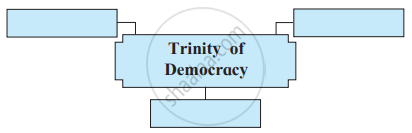
The trinity of democracy comprises three principles. Complete the web to show the trinity of democracy.
Imagine that Revathi’s father is abroad on business and she wishes to convey the news of her prize - winning plants. Draft an email for the above subject.
(Use an email format.)
Write the poem ‘Cherry Tree’ in the form of a story.
Given below are a few famous bridges in India. Find out more information about them and write in your notebook.
- The Howrah Bridge.
- Laxman Zhula
- Pambum Bridge
- Worli Sea Link
Explain the extended metaphor related to dentistry in the poem.
Given below are the prerequisites for an interview. Fill up the boxes with suitable actions to be undertaken with reference to the given points.

Form groups and try to write a script for a short film or documentary on any topic of your choice. The script must develop properly. You can take the help of the following points.
- choose a topic
- central theme
- the beginning, the middle, and the end
- the message
Write in your own words:-
What are the latest modern methods of depositing money in your own or somebody else’s account?
Write the reason in your own words.
Ostad’s song was more elating than Tansen’s songs.
Form groups and discuss each element of planning an interview and prepare notes on each element.
- Format - Structure: ......................
- Size/Length - How much: ......................
- Do’s and Dont’s - Rules and Regulations: ......................
- Type of Questions - Yes/No questions or Wh Type: ......................
Discuss in groups. Draw the haunted house described in the poem and write a paragraph about it in your own words.
Fill in the value trees with the best qualities you like to follow in your life from the given list. Write a few lines about your favourite quality in the box.
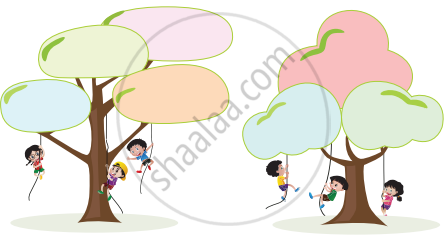
| Best qualities in life | ||||
| Affectionate | Cooperative | Gratitude | Loving | Responsible |
| Ambitious | Courageous | Happiness | Loyal | Self-confident |
| Brave | Dependability | Helpfulness | Good manners | Self-control |
| Calm | Diligence | Honest | Patriotic | Self-esteem |
| Caring | Enthusiastic | Humble | Peaceful | Sensitive |
| Cheerful | Fairness | Imaginative | Perseverance | Sincerity |
| Committed | Faithfulness | Intelligent | Polite | Successful |
| Compassionate | Flexible | Joyful | Positive | Tolerant |
| Concerned | Forgiveness | Kind | Rational | Truthful |
| Confident | Generosity | Leader | Resourceful | Versatile |
| Contented | Giving | Logical | Respect | Witty |
| My favourite quality is... __________________________________________________________________________________ __________________________________________________________________________________ |
||||
Draft Letter for the following.
You are Ajeet, living in a remote village in Tirunelveli. You participated in a health camp organized by your school. You were surprised to observe that most of the residents were unaware of health and hygiene. As a concerned citizen, write a letter to the editor stating the need to organize such camps focusing on the importance of health and hygiene.
Write a character sketch of any character from fiction that has made an impact on you.
- Introduce the person.
- Highlight his/her character as revealed in the story.
- Talk about what others say about the character.
- Write if the character appealed to you, with reasons.
- Support your views with evidence from text.
The words in the clouds describe something or someone in the story. Name them in the blanks provided. Make sentences of your own with the words given in the clouds.

Fill in the blank by choosing the preposition from the option.
The birds were caught ______ the net.
Letters to friends and close family are written in the same way as you speak to them.
|
Krishna Boys’ Hostel writer’s address Model Public School Kolkata 10th July 2000 date My dear Ma, greeting This is my first letter after the summer vacation. We started our classes the day after we reached the hostel. I have settled in well. introduction We have a new teacher for clay modeling and pottery. She tells us how to make fruits and vegetables with clay. We then paint them. They look so real. body We have an inter-house poetry recitation coming up in August. I am really excited about it. It is a long poem but we learn it together with our teacher. It is nice to be back in school with my friends and teachers. I remember you and Baba a lot. Give my love to grandmother and grandfather. ending Do write back soon. Your loving son Pratap, closing |
After reading the letter, answer the following questions.
- Who has written the letter?________
- To whom has the letter been written? ________
- Where is the writer of the letter? _________
- What is the name of his hostel? _________
- On which date was this letter written?________
Do you want to try to write your own paragraph now?
Write a paragraph on Monkey.

- ______
- ______
- ______
- ______
- ______
Who said these words and to whom?
| Who said | To whom | |
| “Wake up, dear! Wake up fast!” | ||
| “Ma, who woke me up today?” | ||
| “Why do you sleep at nine every night?” |
This is Rajiv’s family. They are a healthy family. See what each one does to remain healthy.

Some word have similar sound, but different meaning. Choose the correct word from the option and fill in the blank.
He is our school ______.
In the sentence below the capital letter, comma, full stop and question mark are missing. Put these in the correct place.
oranges mangoes bananas and papayas are fruits
Look at this sentence –
A library is a place where books are kept.
Now fill in the blanks after reading these sentences.
- An ______ is a place where aeroplanes take off and land.
- A ______ is a place where food is cooked.
- A ______ is a place where sick people are taken care of.
- A______is a place where you can buy thing.
- A______ is a place where children study.
Why did they sympathize with the first patient?
Study the pie-chart carefully and answer the questions that follow.
Percentage of people who speak each language as their first language.

- Which language is spoken by most people?
- What are the Indian languages that rank among the top five spoken languages?
- Which are the languages that are spoken by less than three percent of people?
- With the help of the questions and answers, draw your own conclusions from the pie chart. Then, write a paragraph on the popular spoken languages.
The photographer made the author wait for ______.
For what purpose did Aunt Jane wish to use the cheque given by Aunt Jane?
‘Just one more installment and BABY’S REALLY OURS!’ This tells us that the couple
The Government of Tamil Nadu has imposed a ban on the use of plastic. Effective implementation of this ban depends on public awareness and individual responsibility.
Write an article of 150 words for your school magazine to create an awareness of the dangers posed by indiscriminate use of plastic. Expand the ideas given below as notes.
Notes:
a. Introduction
(i) Plastic – synthetic material – doesn’t decompose in soil
(ii) Inevitable role of plastic – man’s day-to-day life
b. Human Health Hazard
(i) Leeching of plastic into food – micro plastic entering food chain
(ii) Human body’s inability to deal with this unnatural substance
(iii) Reaction of microplastic in human body and ill effects
c. Adverse Effects on Plants and Animals
(i) Plastic particles choking waterways – affect aquatic animals
(ii) Ingestion by aquatic and terrestrial animals–blocking of intestines and respiratory passages
d. Environmental Degradation
(i) Manufacturing process and burning of plastics–pollute atmosphere
(ii) Plastic–non-biodegradable – interferes with soil microorganisms – affects soil fertility
e. Conclusion
(i) Suggestions for restricted use – alternatives for one-time use of plastics
(ii) Segregation of plastic waste – for recycling
Why did William and the other children bully Margot?
Answer the following question as briefly as possible and with close reference to the relevant text.
Referring closely to the short story, The Sound Machine, describe the encounter between Klausner and Mrs. Saunders. How did it affirm his belief in his own invention?
Answer the following question as briefly as possible and with close reference to the relevant text.
Discuss how in the poem Dover Beach the poet, Mathew Arnold, reposes faith in love as a beam of hope amidst the surrounding despair.
What was the blue bead?
The line 'The house-roofs seemed to heave and sway' in Browning's poem 'The Patriot' means ______.
Send a formal letter of invitation · in 50 words to Dr. Mehra, noted novelist and educationist, to speak on, The Importance of Books'. You are Lena/Sanjay, Secretary Literary Club, S. S. Public School. Meritionday, date, time and venue.
