Advertisements
Advertisements
Question
The photoelectric work function for a metal surface is 2.3 eV. If the light of wavelength 6800A is incident on the surface of metal, find threshold frequency and incident frequency. Will there be an emission of photoelectrons or not?
[Velocity of light c = 3 x 10⁸ m/s,
Planck’s constant, h = 6.63 * 10-34 Js ]
Advertisements
Solution
Given:
`phi_0=2.3 eV=2.3*1.6*10^-19 J=3.68*10^-19J`
λ=6800 Å=6800*10-10m, c=3*108 m/s, h=6.63*10-34 Js
We know that the incident frequency is given as
`v=c/lambda`
∴`v=(3*10^8)/(6800*10^-10)=4.41*10^14Hz`
Now, if the incident frequency is greater than the threshold frequency, then photoelectrons will be emitted from the metal surface. The threshold frequency is given from work function as
`v_0=phi_0/h`
`v_0=(3.68*10^-19)/(6.63*10^-34)=5.55*10^14Hz`
Since, photoelectrons `v<v_0` will not be emitted.
APPEARS IN
RELATED QUESTIONS
The photoelectric current in a photoelectric cell can be reduced to zero by a stopping potential of 1.8 volt. Monochromatic light of wavelength 2200Å is incident on the cathode. Find the maximum kinetic energy of the photoelectrons in joules. [Charge on electron = 1.6 x 10⁻¹⁹ C]
Write three characteristic features in photoelectric effect that cannot be explained on the basis of wave theory of light, but can be explained only using Einstein's equation.
Two monochromatic beams, one red and the other blue, have the same intensity. In which case (i) the number of photons per unit area per second is larger, (ii) the maximum kinetic energy of the photoelectrons is more? Justify your answer.
Draw a plot showing the variation of photoelectric current versus the intensity of incident radiation on a given photosensitive surface.
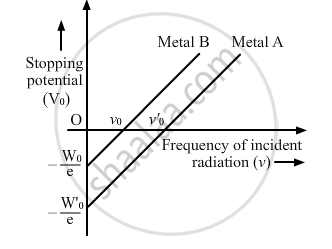
The graph shows the variation of stopping potential with frequency of incident radiation for two photosensitive metals A and B. Which one of the two has higher value of work-function? Justify your answer.
The work functions for potassium and caesium are 2.25 eV and 2.14 eV respectively. Is the photoelectric effect possible for either of them if the incident wavelength is 5180 Å?
[Given : Planck’s constant = 6.63 x 10⁻³⁴ J.s.;
Velocity of light = 3 x 10⁸ m/s; 1 eV = 1.6 x 10⁻¹⁹ J]
If the total energy of radiation of frequency 1014 Hz is 6.63 J, calculate the number of photons in the radiation. (Planck’s constant = 6.63 x 10⁻³⁴ J.s.)
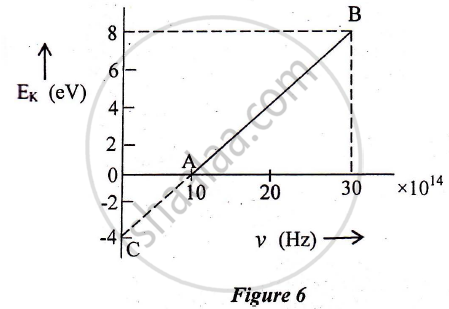
In an experiment of the photoelectric effect, the graph of maximum kinetic energy EK of the emitted photoelectrons versus the frequency v of the incident light is a straight line AB shown in Figure 6 below:
Find:
1) Threshold frequency of the metal
2) The work function of the metal.
3) Stopping potential for the photoelectrons emitted by the light of frequency `v = 30 xx 10^14 Hz`
Draw a plot showing the variation of photoelectric current with collector potential for different frequencies but same intensity of incident radiation ?
What change will you observe if intensity of incident radiation is changed but the frequency remains the same?
A beam of monochromatic radiation is incident on a photosensitive surface. Answer the following question giving reason :
Does the kinetic energy of the emitted electrons depend on the intensity of incident radiation?
Calculate the momentum of a photon of energy 6 x I 0-19 J.
With reference to the photoelectric effect, what is meant by threshold wavelength?
Photoelectric effect is possible ______.
Light of wavelength 4000 Å is incident on two metals A and B. Which metal will emit photoelectrons, if their work functions are 3.8 e V and 1.6 e V respectively?
The phenomenon of photoelectric emission was observed by ______.
Consider an electron in front of metallic surface at a distance d (treated as an infinite plane surface). Assume the force of attraction by the plate is given as `1/4 q^2/(4πε_0d^2)`. Calculate work in taking the charge to an infinite distance from the plate. Taking d = 0.1 nm, find the work done in electron volts. [Such a force law is not valid for d < 0.1nm].
What are the electrons emitted when light falls on a material generally called?
Who discovered the phenomenon of photoelectric emission?
In Hertz’s experimental investigation, how were electromagnetic waves produced?
What happened to high-voltage sparks across the detector loop when the emitter plate was illuminated with ultraviolet light from an arc lamp?
What facilitated the escape of free, charged particles from the metal surface?
Where are the electrons that absorb energy from incident radiation located?
