Advertisements
Advertisements
Question
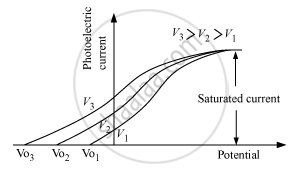
Draw a plot showing the variation of photoelectric current with collector potential for different frequencies but same intensity of incident radiation ?
Advertisements
Solution
Plot showing the variation of photoelectric current with collector potential for different frequencies but same intensity of incident radiation
APPEARS IN
RELATED QUESTIONS
Draw a plot showing the variation of photoelectric current versus the intensity of incident radiation on a given photosensitive surface.
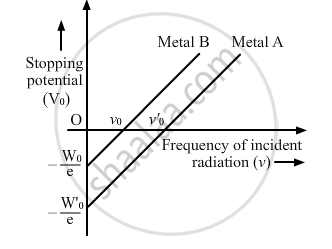
The graph shows the variation of stopping potential with frequency of incident radiation for two photosensitive metals A and B. Which one of the two has higher value of work-function? Justify your answer.
A beam of monochromatic radiation is incident on a photosensitive surface. Answer the following question giving reason :
On what factors does the number of emitted photoelectrons depend?
Calculate the momentum of a photon of energy 6 x I 0-19 J.
State how will you use this graph to detennine the value of Planck's constant.
If the frequency of the incident radiation is increased from 4 × 10¹⁵ Hz to 8 × 10¹⁵ Hz, by how much will the stopping potential for a given photosensitive surface go up?
What are the electrons emitted when light falls on a material generally called?
What facilitated the escape of free, charged particles from the metal surface?
What are the free, charged particles that escape from the metal surface?
Where are the electrons that absorb energy from incident radiation located?
