Advertisements
Advertisements
Question
Light of intensity ‘I’ and frequency ‘v’ is incident on a photosensitive surface and causes photoelectric emission. What will be the effect on anode current when the anode potential is increased? In each case, all other factors remain the same. Explain, giving justification in each case.
Advertisements
Solution
With an increase in the accelerating potential, the photoelectric current increases first, reaches maximum when all the electrons gets collected at the positive potential plate and then remains constant. The maximum value of the anode current is called the saturation current.
APPEARS IN
RELATED QUESTIONS
The photoelectric work function for a metal is 4.2 eV. If the stopping potential is 3V, find the threshold wavelength and maximum kinetic energy of emitted electrons.
(Velocity of light in air = 3 x 10⁸m/s,
Planck's constant = 6·63 x10-34 J -s,
Charg.e ori electron = 1·6 x 10 -19 C)
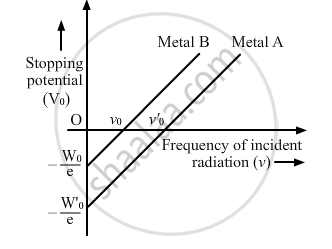
The graph shows the variation of stopping potential with frequency of incident radiation for two photosensitive metals A and B. Which one of the two has higher value of work-function? Justify your answer.
The work functions for potassium and caesium are 2.25 eV and 2.14 eV respectively. Is the photoelectric effect possible for either of them if the incident wavelength is 5180 Å?
[Given : Planck’s constant = 6.63 x 10⁻³⁴ J.s.;
Velocity of light = 3 x 10⁸ m/s; 1 eV = 1.6 x 10⁻¹⁹ J]
A beam of monochromatic radiation is incident on a photosensitive surface. Answer the following question giving reason :
Do the emitted photoelectrons have the same kinetic energy?
In photoelectric effect, why should the photoelectric current increase as the intensity of monochromatic radiation incident on a photosensitive surface is increased? Explain.
Two metals A and B have work functions 4 eV and 6 eV respectively. Which metal has a lower threshold wavelength for photoelectric effect?
If the frequency of the incident radiation is increased from 4 × 10¹⁵ Hz to 8 × 10¹⁵ Hz, by how much will the stopping potential for a given photosensitive surface go up?
The phenomenon of photoelectric emission was observed by ______.
What are the electrons emitted when light falls on a material generally called?
What happened to high-voltage sparks across the detector loop when the emitter plate was illuminated with ultraviolet light from an arc lamp?
