Advertisements
Advertisements
Question
A beam of monochromatic radiation is incident on a photosensitive surface. Answer the following question giving reason :
On what factors does the number of emitted photoelectrons depend?
Advertisements
Solution
The number of emitted photoelectrons depends only on the intensity of the incident light.
APPEARS IN
RELATED QUESTIONS
The photoelectric current in a photoelectric cell can be reduced to zero by a stopping potential of 1.8 volt. Monochromatic light of wavelength 2200Å is incident on the cathode. Find the maximum kinetic energy of the photoelectrons in joules. [Charge on electron = 1.6 x 10⁻¹⁹ C]
The photoelectric work function for a metal is 4.2 eV. If the stopping potential is 3V, find the threshold wavelength and maximum kinetic energy of emitted electrons.
(Velocity of light in air = 3 x 10⁸m/s,
Planck's constant = 6·63 x10-34 J -s,
Charg.e ori electron = 1·6 x 10 -19 C)
Two monochromatic beams, one red and the other blue, have the same intensity. In which case (i) the number of photons per unit area per second is larger, (ii) the maximum kinetic energy of the photoelectrons is more? Justify your answer.
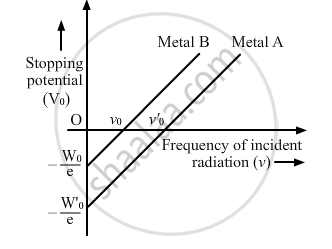
The graph shows the variation of stopping potential with frequency of incident radiation for two photosensitive metals A and B. Which one of the two has higher value of work-function? Justify your answer.
If the total energy of radiation of frequency 1014 Hz is 6.63 J, calculate the number of photons in the radiation. (Planck’s constant = 6.63 x 10⁻³⁴ J.s.)
What change will you observe if intensity of incident radiation is changed but the frequency remains the same?
A beam of monochromatic radiation is incident on a photosensitive surface. Answer the following question giving reason :
Do the emitted photoelectrons have the same kinetic energy?
State how will you use this graph to detennine the value of Planck's constant.
During which experiments did Heinrich Hertz observe photoelectric emission?
In Hertz’s experimental investigation, how were electromagnetic waves produced?
