Advertisements
Advertisements
प्रश्न
A beam of monochromatic radiation is incident on a photosensitive surface. Answer the following question giving reason :
On what factors does the number of emitted photoelectrons depend?
Advertisements
उत्तर
The number of emitted photoelectrons depends only on the intensity of the incident light.
APPEARS IN
संबंधित प्रश्न
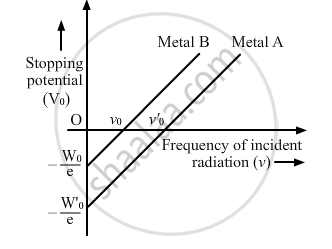
The graph shows the variation of stopping potential with frequency of incident radiation for two photosensitive metals A and B. Which one of the two has higher value of work-function? Justify your answer.
In an experiment of the photoelectric effect, the graph of maximum kinetic energy EK of the emitted photoelectrons versus the frequency v of the incident light is a straight line AB shown in Figure 6 below:
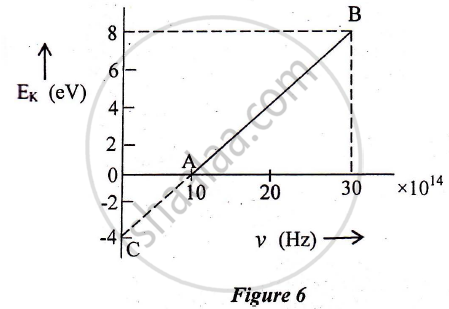
Find:
1) Threshold frequency of the metal
2) The work function of the metal.
3) Stopping potential for the photoelectrons emitted by the light of frequency `v = 30 xx 10^14 Hz`
A beam of monochromatic radiation is incident on a photosensitive surface. Answer the following question giving reason :
Do the emitted photoelectrons have the same kinetic energy?
In photoelectric effect, why should the photoelectric current increase as the intensity of monochromatic radiation incident on a photosensitive surface is increased? Explain.
Calculate the momentum of a photon of energy 6 x I 0-19 J.
What happens when light falling on a material (usually a metal) causes photoelectric emission?
Who discovered the phenomenon of photoelectric emission?
During which experiments did Heinrich Hertz observe photoelectric emission?
In Hertz’s experimental investigation, how were electromagnetic waves produced?
What happened to high-voltage sparks across the detector loop when the emitter plate was illuminated with ultraviolet light from an arc lamp?
