Advertisements
Advertisements
प्रश्न
Draw a neat labelled circuit diagram of experimental arrangement for study of photoelectric effect.
Advertisements
उत्तर

Experimental arrangement for study of photoelectric effect.
S : monochromatic source
E : emitter electrode
C : collector electrode
G : evacuated glass tube
W : quartz window
μA : microammeter
Rh : rheostat
V : voltmeter
B : Battery
APPEARS IN
संबंधित प्रश्न
The photoelectric current in a photoelectric cell can be reduced to zero by a stopping potential of 1.8 volt. Monochromatic light of wavelength 2200Å is incident on the cathode. Find the maximum kinetic energy of the photoelectrons in joules. [Charge on electron = 1.6 x 10⁻¹⁹ C]
Sketch the graphs showing variation of stopping potential with frequency of incident radiations for two photosensitive materials A and B having threshold frequencies vA > vB.
(i) In which case is the stopping potential more and why?
(ii) Does the slope of the graph depend on the nature of the material used? Explain.
The photoelectric work function for a metal is 4.2 eV. If the stopping potential is 3V, find the threshold wavelength and maximum kinetic energy of emitted electrons.
(Velocity of light in air = 3 x 10⁸m/s,
Planck's constant = 6·63 x10-34 J -s,
Charg.e ori electron = 1·6 x 10 -19 C)
Light of intensity ‘I’ and frequency ‘v’ is incident on a photosensitive surface and causes photoelectric emission. What will be the effect on anode current when (i) the intensity of light is gradually increased. In each case, all other factors remain the same. Explain, giving justification in each case.
Light of intensity ‘I’ and frequency ‘v’ is incident on a photosensitive surface and causes photoelectric emission. What will be the effect on anode current when the anode potential is increased? In each case, all other factors remain the same. Explain, giving justification in each case.
Draw a plot showing the variation of photoelectric current versus the intensity of incident radiation on a given photosensitive surface.
If the total energy of radiation of frequency 1014 Hz is 6.63 J, calculate the number of photons in the radiation. (Planck’s constant = 6.63 x 10⁻³⁴ J.s.)
In an experiment of the photoelectric effect, the graph of maximum kinetic energy EK of the emitted photoelectrons versus the frequency v of the incident light is a straight line AB shown in Figure 6 below:
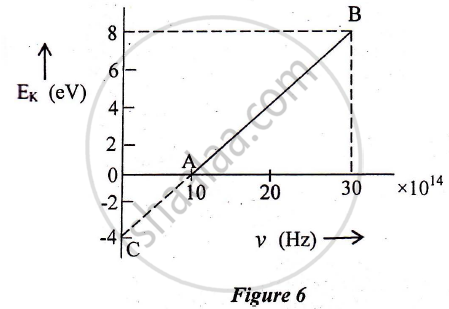
Find:
1) Threshold frequency of the metal
2) The work function of the metal.
3) Stopping potential for the photoelectrons emitted by the light of frequency `v = 30 xx 10^14 Hz`
A photosensitive surface emits photoelectrons when red light falls on it. Will the surface emit photoelectrons when blue light is incident on it? Give reason.
Draw a plot showing the variation of photoelectric current with collector potential for different frequencies but same intensity of incident radiation ?
What change will you observe if intensity of incident radiation is changed but the frequency remains the same?
A beam of monochromatic radiation is incident on a photosensitive surface. Answer the following question giving reason :
Do the emitted photoelectrons have the same kinetic energy?
A beam of monochromatic radiation is incident on a photosensitive surface. Answer the following question giving reason :
On what factors does the number of emitted photoelectrons depend?
Draw a plot showing the variation of photoelectric current with collector plate potential for two different frequencies, v1 > v2, of incident radiation having the same intensity. In which case will the stopping potential be higher? Justify your answer.
Calculate the momentum of a photon of energy 6 x I 0-19 J.
Two metals A and B have work functions 4 eV and 6 eV respectively. Which metal has a lower threshold wavelength for photoelectric effect?
Plot a labelled graph of IVsl where Vs is stopping potential versus frequency f of the incident radiation.
If the frequency of the incident radiation is increased from 4 × 10¹⁵ Hz to 8 × 10¹⁵ Hz, by how much will the stopping potential for a given photosensitive surface go up?
Photoelectric effect is possible ______.
What are the electrons emitted when light falls on a material generally called?
Who discovered the phenomenon of photoelectric emission?
During which experiments did Heinrich Hertz observe photoelectric emission?
What happened to high-voltage sparks across the detector loop when the emitter plate was illuminated with ultraviolet light from an arc lamp?
What facilitated the escape of free, charged particles from the metal surface?
What are the free, charged particles that escape from the metal surface?
