Advertisements
Advertisements
प्रश्न
Draw a plot showing the variation of photoelectric current versus the intensity of incident radiation on a given photosensitive surface.
Advertisements
उत्तर

APPEARS IN
संबंधित प्रश्न
The photoelectric current in a photoelectric cell can be reduced to zero by a stopping potential of 1.8 volt. Monochromatic light of wavelength 2200Å is incident on the cathode. Find the maximum kinetic energy of the photoelectrons in joules. [Charge on electron = 1.6 x 10⁻¹⁹ C]
The photoelectric work function for a metal is 4.2 eV. If the stopping potential is 3V, find the threshold wavelength and maximum kinetic energy of emitted electrons.
(Velocity of light in air = 3 x 10⁸m/s,
Planck's constant = 6·63 x10-34 J -s,
Charg.e ori electron = 1·6 x 10 -19 C)
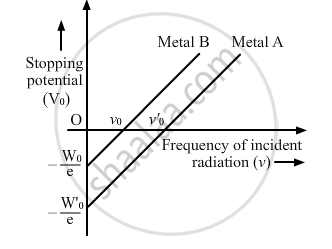
The graph shows the variation of stopping potential with frequency of incident radiation for two photosensitive metals A and B. Which one of the two has higher value of work-function? Justify your answer.
In an experiment of the photoelectric effect, the graph of maximum kinetic energy EK of the emitted photoelectrons versus the frequency v of the incident light is a straight line AB shown in Figure 6 below:
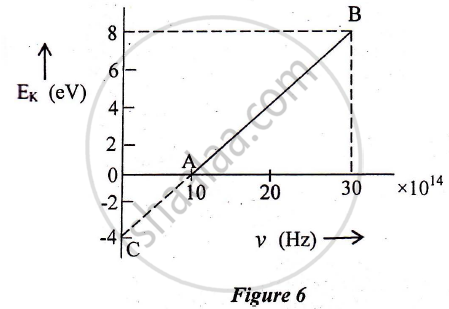
Find:
1) Threshold frequency of the metal
2) The work function of the metal.
3) Stopping potential for the photoelectrons emitted by the light of frequency `v = 30 xx 10^14 Hz`
Draw a plot showing the variation of photoelectric current with collector potential for different frequencies but same intensity of incident radiation ?
Draw a plot showing the variation of photoelectric current with collector plate potential for two different frequencies, v1 > v2, of incident radiation having the same intensity. In which case will the stopping potential be higher? Justify your answer.
What is photoelectri effect ? Defin (i) Stopping potential (ii) Photoelectric work function.
Calculate the momentum of a photon of energy 6 x I 0-19 J.
The phenomenon of photoelectric emission was observed by ______.
Consider an electron in front of metallic surface at a distance d (treated as an infinite plane surface). Assume the force of attraction by the plate is given as `1/4 q^2/(4πε_0d^2)`. Calculate work in taking the charge to an infinite distance from the plate. Taking d = 0.1 nm, find the work done in electron volts. [Such a force law is not valid for d < 0.1nm].
