Advertisements
Advertisements
प्रश्न
Consider an electron in front of metallic surface at a distance d (treated as an infinite plane surface). Assume the force of attraction by the plate is given as `1/4 q^2/(4πε_0d^2)`. Calculate work in taking the charge to an infinite distance from the plate. Taking d = 0.1 nm, find the work done in electron volts. [Such a force law is not valid for d < 0.1nm].
Advertisements
उत्तर
As per question F = `1/4 q^2/(4πε_0d^2)`
Let at any instant electron is at a distance x from the metal surface. Force of attraction between. metal surface and electron is F
F = `1/4 q^2/(4πε_0x^2)`
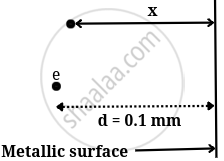
Work done by an external agency in taking the electron from distance d to ∞ is W.D. = `int_d^∞ F*dx`
W.D. = `int_d^∞ (q^2dx)/(4 xx 4πε_0x^2) = q^2/(4 xx 4πε_0) int_d^∞ x^-2 dx = q^2/(4 xx 4πε_0) x^-1/(-1)`
W.D. = `(-q^2)/(4.4πg e_0) [1/x]_d^∞ = (-q^2k)/4 [1/∞ - 1/d]`
W.D. = `(+ kq^2)/(4d)` [d = 0.1 nm = 10–10 m]
Work done is positive
So W.D. = `((1.6 xx 10^-19)^2 xx 9 xx 10^9)/(4 xx 10^-10)`
J = `(1.6 xx 9 xx 1.6 xx 10^(-33+9+10))/(4 xx 1.6 xx 10^-19)` eV
= `(9 xx 1.6 xx 10^(19+19))/4`
= 3.6 eV
APPEARS IN
संबंधित प्रश्न
Write three characteristic features in photoelectric effect that cannot be explained on the basis of wave theory of light, but can be explained only using Einstein's equation.
Sketch the graphs showing variation of stopping potential with frequency of incident radiations for two photosensitive materials A and B having threshold frequencies vA > vB.
(i) In which case is the stopping potential more and why?
(ii) Does the slope of the graph depend on the nature of the material used? Explain.
Two monochromatic beams, one red and the other blue, have the same intensity. In which case (i) the number of photons per unit area per second is larger, (ii) the maximum kinetic energy of the photoelectrons is more? Justify your answer.
Draw a plot showing the variation of photoelectric current versus the intensity of incident radiation on a given photosensitive surface.
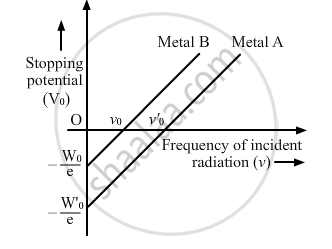
The graph shows the variation of stopping potential with frequency of incident radiation for two photosensitive metals A and B. Which one of the two has higher value of work-function? Justify your answer.
The work functions for potassium and caesium are 2.25 eV and 2.14 eV respectively. Is the photoelectric effect possible for either of them if the incident wavelength is 5180 Å?
[Given : Planck’s constant = 6.63 x 10⁻³⁴ J.s.;
Velocity of light = 3 x 10⁸ m/s; 1 eV = 1.6 x 10⁻¹⁹ J]
If the total energy of radiation of frequency 1014 Hz is 6.63 J, calculate the number of photons in the radiation. (Planck’s constant = 6.63 x 10⁻³⁴ J.s.)
A beam of monochromatic radiation is incident on a photosensitive surface. Answer the following question giving reason :
Do the emitted photoelectrons have the same kinetic energy?
A beam of monochromatic radiation is incident on a photosensitive surface. Answer the following question giving reason :
On what factors does the number of emitted photoelectrons depend?
In photoelectric effect, why should the photoelectric current increase as the intensity of monochromatic radiation incident on a photosensitive surface is increased? Explain.
Two metals A and B have work functions 4 eV and 6 eV respectively. Which metal has a lower threshold wavelength for photoelectric effect?
Plot a labelled graph of IVsl where Vs is stopping potential versus frequency f of the incident radiation.
The phenomenon of photoelectric emission was observed by ______.
In what year was the phenomenon of photoelectric emission discovered?
What happened to high-voltage sparks across the detector loop when the emitter plate was illuminated with ultraviolet light from an arc lamp?
Where are the electrons that absorb energy from incident radiation located?
What must electrons near the metal surface overcome before they can escape?
