Advertisements
Advertisements
Question
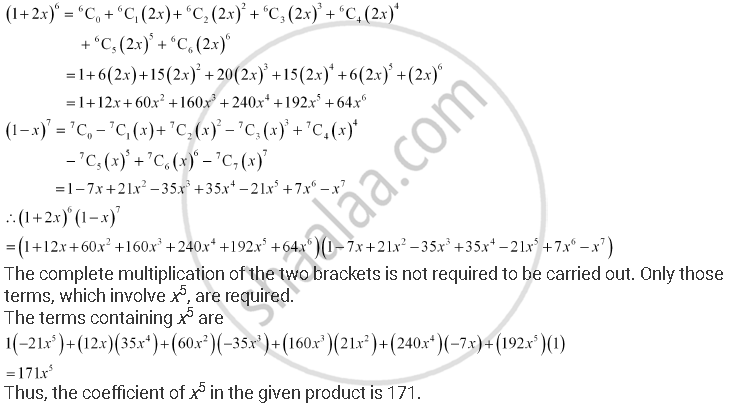
Find the coefficient of x5 in the product (1 + 2x)6 (1 – x)7 using binomial theorem.
Advertisements
Solution
Using Binomial Theorem, the expressions, (1 + 2x)6 and (1 – x)7, can be expanded as
RELATED QUESTIONS
Expand the expression (1– 2x)5
Expand the expression: (2x – 3)6
Using Binomial Theorem, evaluate the following:
(96)3
Using binomial theorem, evaluate f the following:
(101)4
Using Binomial Theorem, indicate which number is larger (1.1)10000 or 1000.
Find (a + b)4 – (a – b)4. Hence, evaluate `(sqrt3 + sqrt2)^4 - (sqrt3 - sqrt2)^4`
Show that 9n+1 – 8n – 9 is divisible by 64, whenever n is a positive integer.
Prove that `sum_(r-0)^n 3^r ""^nC_r = 4^n`
Find a, b and n in the expansion of (a + b)n if the first three terms of the expansion are 729, 7290 and 30375, respectively.
Evaluate `(sqrt3 + sqrt2)^6 - (sqrt3 - sqrt2)^6`
Find the value of `(a^2 + sqrt(a^2 - 1))^4 + (a^2 - sqrt(a^2 -1))^4`
Using binomial theorem determine which number is larger (1.2)4000 or 800?
Find the rth term in the expansion of `(x + 1/x)^(2r)`
Find the 4th term from the end in the expansion of `(x^3/2 - 2/x^2)^9`
Evaluate: `(x^2 - sqrt(1 - x^2))^4 + (x^2 + sqrt(1 - x^2))^4`
Find the coefficient of x11 in the expansion of `(x^3 - 2/x^2)^12`
Find the term independent of x in the expansion of `(sqrt(x)/sqrt(3) + sqrt(3)/(2x^2))^10`.
Find the coefficient of x50 after simplifying and collecting the like terms in the expansion of (1 + x)1000 + x(1 + x)999 + x2(1 + x)998 + ... + x1000 .
The total number of terms in the expansion of (x + a)51 – (x – a)51 after simplification is ______.
If the coefficients of x7 and x8 in `2 + x^n/3` are equal, then n is ______.
The coefficient of xp and xq (p and q are positive integers) in the expansion of (1 + x)p + q are ______.
Find the coefficient of x in the expansion of (1 – 3x + 7x2)(1 – x)16.
If the coefficient of second, third and fourth terms in the expansion of (1 + x)2n are in A.P. Show that 2n2 – 9n + 7 = 0.
In the expansion of (x + a)n if the sum of odd terms is denoted by O and the sum of even term by E. Then prove that 4OE = (x + a)2n – (x – a)2n
Given the integers r > 1, n > 2, and coefficients of (3r)th and (r + 2)nd terms in the binomial expansion of (1 + x)2n are equal, then ______.
The two successive terms in the expansion of (1 + x)24 whose coefficients are in the ratio 1:4 are ______.
The number of terms in the expansion of (x + y + z)n ______.
Number of terms in the expansion of (a + b)n where n ∈ N is one less than the power n.
Let the coefficients of x–1 and x–3 in the expansion of `(2x^(1/5) - 1/x^(1/5))^15`, x > 0, be m and n respectively. If r is a positive integer such that mn2 = 15Cr, 2r, then the value of r is equal to ______.
The sum of the last eight coefficients in the expansion of (1 + x)16 is equal to ______.
The positive integer just greater than (1 + 0.0001)10000 is ______.
