Advertisements
Advertisements
Question
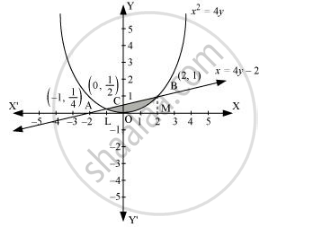
Find the area bounded by the curve x2 = 4y and the line x = 4y – 2
Advertisements
Solution
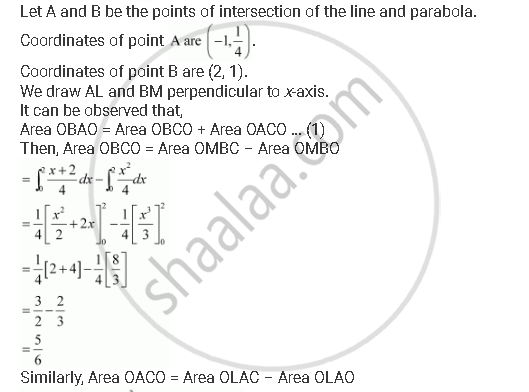
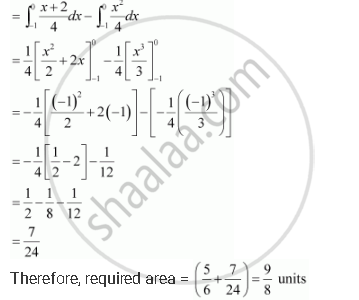
The area bounded by the curve, x2 = 4y, and line, x = 4y – 2, is represented by the shaded area OBAO.
APPEARS IN
RELATED QUESTIONS
Find the area of the region bounded by x2 = 4y, y = 2, y = 4 and the y-axis in the first quadrant.
Find the area of the region bounded by the ellipse `x^2/4 + y^2/9 = 1.`
Find the area of the region in the first quadrant enclosed by x-axis, line x = `sqrt3` y and the circle x2 + y2 = 4.
Area lying in the first quadrant and bounded by the circle x2 + y2 = 4 and the lines x = 0 and x = 2 is ______.
Find the area under the given curve and given line:
y = x4, x = 1, x = 5 and x-axis
Find the area of the region enclosed by the parabola x2 = y, the line y = x + 2 and x-axis
Using the method of integration, find the area of the triangle ABC, coordinates of whose vertices are A (4 , 1), B (6, 6) and C (8, 4).
Find the area enclosed between the parabola 4y = 3x2 and the straight line 3x - 2y + 12 = 0.
Find the area bounded by the circle x2 + y2 = 16 and the line `sqrt3 y = x` in the first quadrant, using integration.
Using integration, find the area of the region {(x, y) : x2 + y2 ≤ 1 ≤ x + y}.
Draw a rough sketch and find the area bounded by the curve x2 = y and x + y = 2.
Find the area of the region.
{(x,y) : 0 ≤ y ≤ x2 , 0 ≤ y ≤ x + 2 ,-1 ≤ x ≤ 3} .
Using integration find the area of the triangle formed by negative x-axis and tangent and normal to the circle `"x"^2 + "y"^2 = 9 "at" (-1,2sqrt2)`.
Find the area of the region bounded by the following curves, the X-axis and the given lines:
y = x2 + 1, x = 0, x = 3
The area of the region bounded by y2 = 4x, the X-axis and the lines x = 1 and x = 4 is _______.
If the curve, under consideration, is below the X-axis, then the area bounded by curve, X-axis and lines x = a, x = b is positive.
Solve the following :
Find the area of the region bounded by the curve y = x2 and the line y = 10.
Choose the correct alternative:
Using the definite integration area of the circle x2 + y2 = 16 is ______
Area of the region bounded by the curve x = y2, the positive Y axis and the lines y = 1 and y = 3 is ______
Choose the correct alternative:
Area of the region bounded by the parabola y2 = 25x and the lines x = 5 is ______
The area of the circle x2 + y2 = 16 is ______
The area of the region x2 = 4y, y = 1 and y = 2 and the Y axis lying in the first quadrant is ______
Find the area of the region bounded by the curve y = `sqrt(9 - x^2)`, X-axis and lines x = 0 and x = 3
Find area of the region bounded by 2x + 4y = 10, y = 2 and y = 4 and the Y-axis lying in the first quadrant
Find the area of the circle x2 + y2 = 16
The area bounded by y = `27/x^3`, X-axis and the ordinates x = 1, x = 3 is ______
`int "e"^x ((sqrt(1 - x^2) * sin^-1 x + 1)/sqrt(1 - x^2))`dx = ________.
Equation of a common tangent to the circle, x2 + y2 – 6x = 0 and the parabola, y2 = 4x, is:
The area (in sq.units) of the part of the circle x2 + y2 = 36, which is outside the parabola y2 = 9x, is ______.
If area of the region bounded by y ≥ cot( cot–1|In|e|x|) and x2 + y2 – 6 |x| – 6|y| + 9 ≤ 0, is λπ, then λ is ______.
The area bounded by the x-axis and the curve y = 4x – x2 – 3 is ______.
Area bounded by y = sec2x, x = `π/6`, x = `π/3` and x-axis is ______.
Find the area of the region lying in the first quadrant and bounded by y = 4x2, x = 0,y = 2 and y = 4.
For an area bounded by \[x=g(y)\], the \[y\]-axis, and the horizontal lines \[y=c\] and \[y=d\], which strips are used?
Why cannot a curve crossing the \[x\]-axis within \[a,b\] be integrated directly from \[a\] to \[b\] to obtain total area?
