Advertisements
Advertisements
Question
Explain the following line with reference to the context in about 5 to 8 line:
“Comes at the last, and with a little pin
Bores through his castle wall, and farewell king!”
Advertisements
Solution
- Reference: These lines are from the poem “The Hollow Crown” by William Shakespeare. The poem is an excerpt from the play “Richard II”.
- Context: King Richard says these words while discussing the power of death over kings.
- Explanation: A king when he is ruling a country, looks very strong. He seems to be like an impregnable brass castle. But death with a small pinprick can easily shatter the castle. It can bid farewell easily to the king and send him to heaven.
- Comment: Death may be the greatest of all human blessings.
APPEARS IN
RELATED QUESTIONS
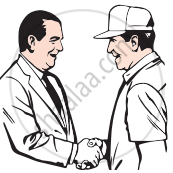
Guess what friendly words these two gentlemen exchange when shaking hands.
What does he desire to unlearn and relearn?
Explain the following lines with reference to the context.
Once upon a time, son They used to laugh with their eyes:
Not everybody loves to play and participate in games, sports and other extra-curricular activities. Some of us wish to be mere spectators. List out the activities in which you like to be either a performer or a spectator. Share your views with the class.
| Activities | ||
| performer/player | spectator/audience | |
| e.g. | cricket | magician |
| a. | ||
| b. | ||
| c. | ||
| d. | ||
| e. | ||
Why would the referee ask whether there was a doctor in the stands? What stands is he referring to?
Why do accidents usually happen in the playground? Give your own examples and explain
You are the School Pupil Leader. Mention some qualities that can be drawn from the field of sports to improve your leadership skills.
Read the lines given below and answer the question that follow.
And I must think, do all I can,
That there was pleasure there…
- What did the poet notice about the twigs?
- What was the poet’s thought about then?
Read the following line and identify the figure of speech used in each extract.
What Man has made of Man?
How do people bring grief and sorrow to one another?
The poet finds joy in various objects of Nature. Explain.
The poet experiences sadness because ______.
Work in groups of 4−6. Discuss how you would preserve the environment and protect Nature. One or two representatives may share their ideas with the class.
When humanity fails to live in harmony with Nature, its effects are felt around the world. Why and how?
A French proverb goes thus: ‘The dog may be wonderful prose, but only the cat is poetry.’ You may have observed that all animals possess a number of unique qualities. Fill in the columns with words and phrases associated with each of the following animals.
| DOG | CAT | WOLF | ELEPHANT |
Who are the ‘deserving ones’?
Which quality does the speaker wish to nourish? What is his mission?
Why does the speaker say ‘Everest is not the only peak’?
In what way is every hillock similar to Everest?
Fill in the blank with appropriate word from the box and complete the statement suitably:
Shravan never keeps his promises. His friends know that his words are ______.
Fill in the blank with appropriate word from the box and complete the statement suitably:
The business woman wished to ______all her riches to an orphanage, after her death.
What are the various functions and objects given up by a defeated king?
Explain the following line with reference to the context in about 5 to 8 line:
“How can you say to me, I am a king?”
Working with your partner, discuss the following adages and share your views with the class. You may need to give your ideas and justify your point of view. Remember to take turns while making your presentation/short speech.
War begets war
Read the poem once again carefully and identify the figure of speech that has been used in each of the following line from the poem:
“Keeps Death his court, and there the antic sits,…”
Based on your reading of King Richard’s speech, answer the following questions in about 100 - 150 words each. You may add your own ideas if required to present and justify your point of view.
How are eternal truths and wisdom brought to the reader here?
Based on your reading of King Richard’s speech, answer the following questions in about 100 - 150 words each. You may add your own ideas if required to present and justify your point of view.
Who does the future generations remember easily - the victor or the vanquished? Give reasons. Also, cite relevant references from King Richard’s speech.
