Advertisements
Advertisements
Question
Read the given line and answer the question that follow.
Honour is a property, common to all: In dignity and pride no one need to be poor.
- Who are considered rich?
- What is their asset?
Advertisements
Solution
- Those who possess dignity and pride are considered rich.
- Honour is their asset.
APPEARS IN
RELATED QUESTIONS
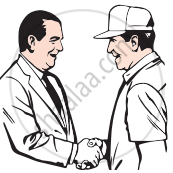
Guess what friendly words these two gentlemen exchange when shaking hands.
What do you associate with the title of the poem?
What is the relationship between the narrator and the listener?
Interpret each of the following expression used in the poem, in one or two line.
to unlearn all these muting things
Explain the following line with reference to the context.
There will be no thrice.
Why would the referee ask whether there was a doctor in the stands? What stands is he referring to?
Do you go for leisurely walks? If you are a city-dweller, what or who would you expect to see on your way?
Find words from the poem that convey the following ideas:
- connected together
- spread over the surface of the ground in a straggling manner
- make out or understand
- slender woody shoots growing from branches or stems of trees
Read the following line and identify the figure of speech used in each extract.
What Man has made of Man?
Where can you encounter Macavity?
What is Macavity expected to be doing after committing a crime?
Why is Macavity called the ‘Napoleon of Crime’?
Read the given lines and answer the question that follow.
And his footprints are not found in any file of Scotland Yard’s.
- What seems to be a challenge for the Scotland Yard?
- Why do they need his footprints?
Read the given lines and answer the question that follow.
‘It must have been Macavity!’ but he’s a mile away.
- What is Macavity blamed for?
- Where is he?
Read the given lines and answer the question that follow.
There never was a Cat of such deceitfulness and suavity.
- Which cat is being talked of here?
- How is he different from the rest?
Explain the following line with reference to the context.
And his footprints are not found in any file of Scotland Yard’s
Explain the following line with reference to the context.
There may be a scrap of paper in the hall or on the stair
But it’s useless to investigate…
Read the given line and answer the question that follow.
We are proud of the position we hold; humble as we are
- What is the speaker proud of?
- How is the speaker both humble and proud?
- Pick out the alliteration in these lines.
Discuss the following topics in groups of five and choose a representative to sum up the views and share them with the class.
To succeed in life, one must have a single-minded devotion to duty.
Fill in the blanks using the words given in the box to complete the summary of the poem:
King Richard the Second, had surrendered to his (a)______cousin, Bollingbroke. He experienced deep distress at the horror of his circumstances. In that desperate situation, he speaks of (b)______, (c)______, (d)______and other things connected with death. He spoke of how people leave nothing behind and can call nothing their own, except for the small patch of (e)______, where they will be buried. King Richard yielded to dejection and talked of all the different ways in which defeated kings suffer how some had been deposed, (f)______in war, (g)______by their wives and so forth. He attributed this loss of lives to (h)______, who he personified as the jester who watches over the shoulder of every ruler, who mocks kings by allowing them to think their human flesh, was like (i)______brass. However, Death penetrates through the castle walls, silently and unnoticed like a sharp (j)______, thus bidding (k)______to him and all his pride forever. Finally, Richard appealed to his soldiers not to mock his mere flesh and blood by showing (l) ______and respect to him. He added that he too needed bread to live, felt want, tasted (m)______and needed (n)______. He concluded thus, urging his men not to call him a (o)______as he was only human, just like the rest of them.
| barren-earth | friends | graves | slain |
| rebellious | poisoned | worms | grief |
| impregnable | epitaphs | death | farewell |
| reverence | king | pin |
Are all deposed kings slain by the deposer?
Read the poem once again carefully and identify the figure of speech that has been used in each of the following line from the poem:
“Let’s talk of graves, of worms, and epitaphs;
Make dust our paper, and with rainy eyes Write sorrow on the bosom of the earth’’.
Read the poem once again carefully and identify the figure of speech that has been used in each of the following line from the poem:
“Keeps Death his court, and there the antic sits,…”
Pick out the alliteration from the following lines:
“Our lands, our lives, and all, are Bolingbroke’s,…”
