Advertisements
Advertisements
Question
Explain sexual reproduction in plants.
Advertisements
Solution

- In sexually reproducing plants, flowers function as the reproductive organs.
- In flowers, male organ is the stamen and female organ is the carpel.
- Flowers which have both the male and female organs i.e. stamens and carpels are called bisexual flowers whereas flowers which have either male or female organs are called unisexual.
- Male gametes called pollen grains are produced by stamen, and carpels produce female gametes called ovules or egg cells inside ovaries.
- Fertilization takes place in the ovule where the egg cell and pollen grain fuse.
- This fertilized egg cell later develops into an embryo and the entire ovule gets converted into a seed.
- Under favourable conditions, the seed germinates to give rise to a new plant.
APPEARS IN
RELATED QUESTIONS
What is pollination?

(i) Name the part marked 'A' in the diagram.
(ii) How dose 'A' reachese part 'B'?
(iii) State the importance of the part 'C'.
(iv) What happens to the part marked 'D' after fertilisation is over?
A student identified the various parts of an embryo of a gram seed and listed them as given below :
(I) Testa
(II) Plumule
(III) Radicle
(IV) Cotyledon
(V) Tegmen
Out of these the actual parts of the embryo are :
(A) I, II, III
(B) II, III, IV
(C) III, IV, V
(D) II, IV, V
State the name of the functional unit concerned with sexual reproduction.
Name the male part of the flower.
What is the function of a flower?
Fill in the following blank with suitable word :
The ovary of a flower becomes ....... after fertilisation.
Fill in the following blank with suitable word :
The ovule becomes a .......... after fertilisation.
Fill in the following blank with suitable word :
Flowering plants reproduce by ...........method of reproduction.
Give some examples of different modes of fertilisation in nature?
Name the part of a seed which grows into shoot.
The part of a seed which grows and develops into root on germination is :
(a) cotyledon
(b) plumule
(c) follicle
(d) radicle
Fill in the blank by selecting suitable word:
A flower bearing only male or female parts is known as __________ flower.
Multiple choice question. Tick (✓) the correct choice:
The male gamete is present inside the which germinates.
- the style
- the stigma
- the anther
- the ovary
Fill in the blank:
Seeds are formed from________.
The students of a class were asked by the teacher to study the different parts of an embryo of an angiosperm. Given below are the essential steps for the experiment :
A. Soak the seeds in plain water and keep them overnight.
B. Cut open the soaked seed and observe its different parts.
C. Take some healthy seeds in a petri-dish.
D. Drain the excess water, cover the seeds with a wet cotton cloth and leave them as it is for a day.
The correct sequence of these steps is
(a) C, A, D, B
(b) C, D, A, B
(c) A, C, D, B
(d) A, C, B, D
In the figure, the parts marked A, B and C are sequentially:

(A) Plumule, Radicle and Cotyledon
(B) Radicle, Plumule and Cotyledon
(C) Plumule, Cotyledon and Radicle
(D) Radicle, Cotyledon and Plumule
Write the names of male and female reproductive parts of a flower.
Describe an activity to demonstrate phototropism.
Identify the odd. Stigma, Style, Pollen, Ovary.
A student is observing the temporary mount of a leaf peel under a microscope. Draw a labelled diagram of the structure of stomata as seen under the microscope
Bisexual : Hibiscus : : Unisexual : ___________
Pollen grains from anther are transferred to the stigma.
Write the functions of sepals
Explain the sexual reproduction process in plants with a diagram.
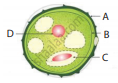
Identify the parts A, B, C, and D?
Which of the following are the chemical components of the wall of pollen tube?
Gloriosa superba exhibits ______.
Which out of the following processes does not lead to the formation of clones.
Which among the following statements are true for sexual reproduction in flowering plants?
- It requires two types of gametes
- Fertilisation is a compulsory event
- It always results in formation of zygote
- Offspring formed are clones
The ovaries of different flowers may contain ______.
Trace the path a male gamete takes to fertilise a female gamete after being released from the penis.
Double fertilization means ______.
What are the agents for pollination?
The pollen tube usually enters the embryo sac ______.
