Advertisements
Advertisements
Questions
Draw all the isomers (geometrical and optical) of [Co(NH3)Cl(en)2]2+.
Write the structures of all the possible stereoisomers of the complex [CoCl(en)2(NH3)]2+.
Advertisements
Solution
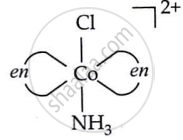
trans-isomer
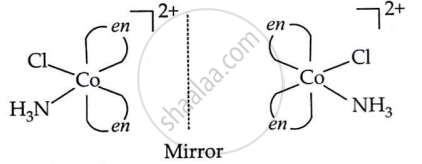
cis-isomer optical isomerism
APPEARS IN
RELATED QUESTIONS
When a coordination compound CoCl3.6NH3 is mixed with AgNO3, 3 moles of AgCl are precipitated per mole of the compound. Write the structural formula of the coordination compound.
Draw one of the geometrical isomers of the complex [Pt (en)2Cl2] +2 which is optically inactive
Draw the geometrical isomers of complex \[\ce{[Co(en)2Cl2]+}\].
Draw the geometrical isomers of complex [Pt(NH3)2Cl2].
What type of isomerism is exhibited by the complex [Co(en)3]3+?
(en = ethane-1,2-diamine)
Indicate the type of isomerism exhibited by the following complex and draw the structure for the isomer:
[Pt(NH3)(H2O)Cl2]
How many geometrical isomers are possible in the following coordination entity?
[Cr(C2O4)3]3−
Draw the structure of optical isomers of [PtCl2(en)2]2+.
Draw all the isomers (geometrical and optical) of [CoCl2(en)2]+.
Write the structures of optical isomers of the complex ion [Co(en)2Cl2]+.
Why is Butan-1-ol optically inactive but Butan-2-ol is optically active?
Draw the geometrical isomers of complex [Pt(en)2Cl2]2+.
What type of structural isomers are [Co(NH3)5 Br] SO4 and [Co(NH3)5 SO4]Br? Give a chemical test to distinguish the isomers.
Name the type of isomerism that the compound with molecular formula C3H6O2 exhibits. Represent the isomers.
Name the type of isomerism shown by the following pair of compounds:
[CoCl(H2O)(NH3)4]Cl2 and [CoCl2(NH3)4]Cl.H2O
Indicate the types of isomerism exhibited by the following complexes and draw the structures for these isomers:
[Pt(NH3)(H2O)Cl2 ]
Assertion: Addition of bromine water to 1-butene gives two optical isomers.
Reason: The product formed contains two asymmetric carbon atoms.
Indicate the type of isomerism exhibited by the following complex and draw the structure for this isomer: \[\ce{[Pt(NH3)(H2O)Cl2]}\]
Indicate the types of isomerism exhibited by the following complex and draw the structure for these isomer: \[\ce{[Pt(NH3)(H2O)Cl2]}\]
Indicate the types of isomerism exhibited by the following complex and draw the structure for this isomer:
\[\ce{[Pt(NH3)(H2O)Cl2]}\]
