Advertisements
Advertisements
Question
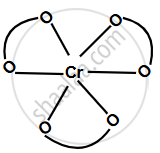
How many geometrical isomers are possible in the following coordination entity?
[Cr(C2O4)3]3−
Advertisements
Solution
It is a complex [Cr(C2O4)3]3− of the type [M(AA)3]± and is unable to show geometrical isomerism. Hence, no geometric isomer is possible as it is a bidentate ligand.
APPEARS IN
RELATED QUESTIONS
When a coordination compound CoCl3.6NH3 is mixed with AgNO3, 3 moles of AgCl are precipitated per mole of the compound. Write the structural formula of the coordination compound.
Indicate the type of isomerism exhibited by the following complex and draw the structure for the isomer:
[Co(NH3)5(NO2)](NO3)2
Indicate the type of isomerism exhibited by the following complex and draw the structure for the isomer:
[Pt(NH3)(H2O)Cl2]
How many geometrical isomers are possible in the following coordination entity?
[Co(NH3)3Cl3]
Draw all the isomers (geometrical and optical) of [CoCl2(en)2]+.
Draw all the isomers (geometrical and optical) of [Co(NH3)Cl(en)2]2+.
Write all the geometrical isomers of [Pt(NH3)(Br)(Cl)(py)] and how many of these will exhibit optical isomers?
Name the type of isomerism exhibited by the following pairs of compound:
(1) (C2H5)2NH and CH3-NH-C3H7
(2) 1 – butanol and 2 methyl-1 -propanol.
Name the type of isomerism shown by the following pair of compounds:
[CoCl(H2O)(NH3)4]Cl2 and [CoCl2(NH3)4]Cl.H2O
Write the IUPAC name of [Co(en)2Cl2]+ ion.
The IUPAC name for [CoCl(NO2)(en)2]Cl is ____________.
Identify the optically active compounds from the following:
(i) \[\ce{[Co(en)3]^{3+}}\]
(ii) \[\ce{[trans - [Co(en)2Cl2]^+}\]
(iii) \[\ce{cis - [Co(en)2Cl2]^+}\]
(iv) \[\ce{[Cr(NH3)5Cl]}\]
Indicate the types of isomerism exhibited by the following complexes and draw the structures for these isomers:
[Pt(NH3)(H2O)Cl2 ]
Indicate the type of isomerism exhibited by the following complex and draw the structure for this isomer:
[Pt(NH3)(H2O)Cl2]
Indicate the type of isomerism exhibited by the following complex and draw the structure for this isomer: \[\ce{[Pt(NH3)(H2O)Cl2]}\]
Indicate the types of isomerism exhibited by the following complex and draw the structure for this isomer:
\[\ce{[Pt(NH3)(H2O)Cl2]}\]
Indicate the types of isomerism exhibited by the following complex and draw the structure for this isomer:
\[\ce{[Pt(NH3)(H2O)Cl2]}\]
Indicate the type of isomerism exhibited by the following complex and draw the structure for the isomer:
\[\ce{[Pt(NH3 )(H2O)Cl2]}\]
