Advertisements
Advertisements
प्रश्न
Draw all the isomers (geometrical and optical) of [Co(NH3)Cl(en)2]2+.
Write the structures of all the possible stereoisomers of the complex [CoCl(en)2(NH3)]2+.
Advertisements
उत्तर
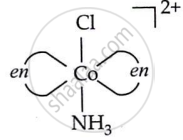
trans-isomer
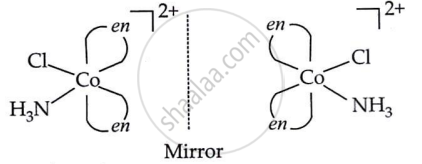
cis-isomer optical isomerism
APPEARS IN
संबंधित प्रश्न
Draw one of the geometrical isomers of the complex [Pt(en)2Cl2]2+ which is optically active.
What type of isomerism is exhibited by the complex [Co(en)3]3+?
(en = ethane-1,2-diamine)
Indicate the type of isomerism exhibited by the following complex and draw the structure for the isomer:
K[Cr(H2O)2(C2O4)2]
Indicate the type of isomerism exhibited by the following complex and draw the structure for the isomer:
[Co(NH3)5(NO2)](NO3)2
Draw the structure of optical isomers of [PtCl2(en)2]2+.
Draw the structure of optical isomers of [Cr(NH3)2Cl2(en)]+.
Draw all the isomers (geometrical and optical) of [CoCl2(en)2]+.
Draw all the isomers (geometrical and optical) of [Co(NH3)2Cl2(en)]+.
What type of isomers are `[Co(NH_3)_5Br]SO_4`and `[Co(NH_3)_5SO_4]Br`?. Give a chemical test to distinguish between them.
Draw the geometrical isomers of complex [Pt(en)2Cl2]2+.
The complex [(Pt(Py)(NH3)BrCl] will have how many geometrical isomers?
Assertion (A): Trans [CrCl2(ox)2]3− shows optical isomerism.
Reason (R): Optical isomerism is common in octahedral complexes involving didentate ligands.
Indicate the types of isomerism exhibited by the following complexes and draw the structures for these isomers:
[Pt(NH3)(H2O)Cl2 ]
Indicate the type of isomerism exhibited by the following complex and draw the structure for this isomer:
[Pt(NH3)(H2O)Cl2]
Indicate the type of isomerism exhibited by the following complex and draw the structure for this isomer: \[\ce{[Pt(NH3)(H2O)Cl2]}\]
Indicate the types of isomerism exhibited by the following complexes and draw the structure for these isomer:
\[\ce{[Pt(NH3)(H2O)Cl2]}\]
Indicate the types of isomerism exhibited by the following complex and draw the structure for this isomer:
\[\ce{[Pt(NH3)(H2O)Cl2]}\]
Indicate the types of isomerism exhibited by the following complex and draw the structure for this isomer:
\[\ce{[Pt(NH3)(H2O)Cl2]}\]
Indicate the type of isomerism exhibited by the following complex and draw the structure for the isomer:
\[\ce{[Pt(NH3 )(H2O)Cl2]}\]
