Advertisements
Advertisements
प्रश्न
Answer the following question.
Write IUPAC name of the complex [Pt(en)2CI2]. Draw structures of geometrical isomers for this complex.
Advertisements
उत्तर
IUPAC name of the complex [Pt(en)2CI2] is Dichlorido bis(ethane-1,2-diammine) platinum(II).
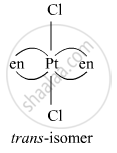
The structures of geometrical isomers for this complex are:
[Pt(en)2CI2]

APPEARS IN
संबंधित प्रश्न
Draw the geometrical isomers of complex [Pt(NH3)2Cl2].
Indicate the type of isomerism exhibited by the following complex and draw the structure for the isomer:
[Co(en)3]Cl3
Draw the structure of optical isomers of [PtCl2(en)2]2+.
Draw all the isomers (geometrical and optical) of [CoCl2(en)2]+.
Why is Butan-1-ol optically inactive but Butan-2-ol is optically active?
Name the type of isomerism exhibited by the following pairs of compound:
(1) (C2H5)2NH and CH3-NH-C3H7
(2) 1 – butanol and 2 methyl-1 -propanol.
Identify the optically active compounds from the following:
(i) \[\ce{[Co(en)3]^{3+}}\]
(ii) \[\ce{[trans - [Co(en)2Cl2]^+}\]
(iii) \[\ce{cis - [Co(en)2Cl2]^+}\]
(iv) \[\ce{[Cr(NH3)5Cl]}\]
Indicate the types of isomerism exhibited by the following complexes and draw the structure for isomers:
\[\ce{[Pt(NH3)(H2O)Cl2]}\]
Assertion: Addition of bromine water to 1-butene gives two optical isomers.
Reason: The product formed contains two asymmetric carbon atoms.
Indicate the types of isomerism exhibited by the following complex and draw the structure for these isomer: \[\ce{[Pt(NH3)(H2O)Cl2]}\]
