Advertisements
Advertisements
Question
Distinguish between RNA and DNA.
Advertisements
Solution
| Sr. No. | RNA | DNA |
| 1. | The majority of the RNA is contained in the cytoplasm. | It mainly occurs within the nucleus and specific cell organelles. |
| 2. | Apart from specific viruses, RNA does not serve as the genetic material. | DNA represents the genetic material. |
| 3. | RNA is single-stranded, except in some viruses (e.g., double stranded in Reovirus). | Unlike certain viruses (e.g., Φ × 174), it is double-stranded. |
| 4. | There are at least three types of RNA: mRNA, rRNA, and tRNA. | There are only two types of DNA: intranuclear and extranuclear. |
| 5. | It contains ribose sugar. | It contains deoxyribose sugar. |
| 6. | Thymine is substituted with uracil in RNA, whereas the other three are similar: adenine, cytosine, and guanine. | Nitrogen bases in DNA include adenine, cytosine, guanine, and thymine. |
| 7. | Many unusual or modified bases are frequently present. | Unusual bases are scarce or nonexistent. |
| 8. | Base pairing via hydrogen bonds occurs exclusively in the coiled portions. | Hydrogen bonds develop between complementary nitrogen bases on the opposite strands of DNA (A-T and C-G). |
| 9. | The strand may fold at points to form a secondary helix or pseudohelix. | DNA is spirally twisted to form a regular helix. |
| 10. | It cannot usually reproduce itself. | It replicates to produce new DNA molecules. |
| 11. | RNA transforms the transcribed message into polypeptides. | DNA transcribes genetic information into RNA. |
| 12. | The RNA quantity in a cell is variable. | The quantity is fixed for each cell. |
| 13. | There is no association between the number of purine and pyrimidine bases. | There are an equal number of purine and pyrimidine bases. |
| 14. | It exists in ribosomes or establishes a connection with them. | It takes the form of a prochromosome, chromatin, or chromosomes. |
| 15. | Some RNAs are extremely short-lived, whereas others are slightly longer. | It is long-lived. |
RELATED QUESTIONS
Distinguish between plasmid DNA and chromosomal DNA.
Explain what are the desirable characteristics of an ideal cloning vector used in rDNA technology.
Give the steps in PCR or polymerase chain reaction with suitable diagrams.
Ti plasmid being used for introducing genes in plants obtained from ______.
Polymerase chain reaction is most useful in ______.
Define biotechnology? Which are the basic principles and process of biotechnology?
Explain types of enzymes used in biotechnology?
Which of the following DNA sequence is recognised and cut by EcoR I?
____________ cuts the DNA within the specific positions.
Which molecules are called molecular scissors? Why are they called so?
What would happen when one grows a recombinant bacterium in a bioreactor but forget to add antibiotic to the medium in which the recombinant is growing?
Study the following lists and choose the correct match.
| List I | List II |
| A. Vector | (i) Resistant to cotton bollworms |
| B. Downstream processing | (ii) Mobile genetic elements |
| C. Cry II AB | (iii) Controls corn borers |
| D. Transposons | (iv) Ti plasmid |
| (v) Purifying protein in biopharmaceuticals |
pBR322, used very frequently in cloning experiments as a vector in E. coli is ______.
Tissue plasminogen activator and urokinase are used in the treatment of ______.
What is EcoRI?
Give a reason for the following:
DNA cannot enter directly into the host cell.
State the steps involved in the process of gene therapy for the treatment of ADA-deficiency.
Give a reason for the following:
The diagram given below represents vector pBr322 which was modified by a research scholar Dr. Rayon, but the vector was rejected by his guide.
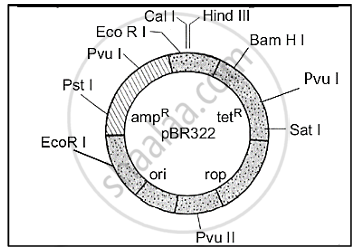
According to the European Federation of Biotechnology (EFB), biotechnology is defined as:
Which of the following best describes the relationship between genetic engineering and recombinant DNA?
