Advertisements
Advertisements
Question
Discuss the following in pairs or in small groups.
‘Luck is necessary for success in life’.
Advertisements
Solution
There are many who believe luck is important and one may find many such who believe in hard work. It is not thought that those who believe in luck do not work hard. It is just that they believe in “do your best and God will do the rest, However, there are those who completely blame their fate for everything and do not do anything to change or improve it. Still, there are people that believe that hard work is greater than luck and that it has the power to change destiny. One may find various beliefs around them and it depends on what they chose to believe in.
APPEARS IN
RELATED QUESTIONS
Read the passage given below and answer the questions that follow:
The term dietary fibres refers collectively to indigestible carbohydrates present in plant foods. The importance of these dietary fibres came into the picture when it was observed that the people having diet rich in these fibres, had low incidence of coronary heart disease, irritable bowel syndrome, dental caries and gall stones.
The foodstuffs rich in these dietary fibres are cereals and grains, legumes, fruits with seeds, citrus fruits, carrots, cabbage, green leafy vegetables, apples, melons, peaches, pears etc.
These dietary fibres are not digested by the enzymes of the stomach and the small intestine whereas most of other carbohydrates like starch and sugar are digested and absorbed. The dietary fibres have the property of holding water and because of it, these get swollen and behave like a sponge as these pass through the gastrointestinal tract. The fibres add bulk to the diet and increase transit time in the gut. Some of these fibres may undergo fermentation in the colon.
In recent years, it has been considered essential to have some amount of fibres in the diet. Their beneficial effects lie in preventing coronary heart disease, and decreasing cholesterol level. The fibres like gums and pectin are reported to decrease postprandial (after meals) glucose level in blood. These types of dietary fibres are recommended for the management of certain types of diabetes. Recent studies have shown that the fenugreek (Methi) seeds, which contain 40 per cent gum, are effective in decreasing blood glucose and cholesterol levels as compared to other gum containing vegetables.
Some dietary fibres increase transit time and decrease the time of release of ingested food in colon. The diet having less fibres is associated with colon cancer and the dietary fibres may play a role in decreasing the risk of it.
The dietary fibres hold water so that stools are soft, bulky and readily eliminated. Therefore high fibre intake prevents or relieves constipation.
The fibres increase motility of the small intestine and the colon and by decreasing the transit time there is less time for exposure of the mucosa to harmful toxic substances. Therefore, there is a less desire to eat and the energy intake can be maintained within the range of requirement. This phenomenon helps in keeping a check on obesity. Another reason in helping to decrease obesity is that the high-fibre diets have somewhat lower coefficients of digestibility.
The dietary fibres may have some adverse effects on nutrition by binding some trace metals like calcium, magnesium, phosphorus, zinc and others and therefore preventing their proper absorption. This may pose a possibility of nutritional deficiency especially when diets contain marginal levels of mineral elements. This may become important constraints on increasing dietary fibres. It is suggested that an intake of 40 grams dietary fibres per day is desirable.
(Extracted from ‘The Tribune’)
(a) On the basis of your reading of the above passage make notes on it in points only, using recognizable abbreviations wherever necessary. Also suggest a suitable title. (5)
(b) Write a summary of the above in about 80 words. (3)
We know that chimps are intelligent because
Read the passage carefully and complete the activities given below :
A1 True or False
A2 Mention the two things that were found when the tall grass was hacked.
A3 The narrator prayed that Rex should not make any sudden movements meets. Explain giving reasons.
Comment on the graphic detail with which the various passengers who took Iona's cab are described.
Explain the line:
She makes too much steam–you want to hang the monkey wrench on the safety valve!
Identify some of the improbable images the author has used to effect greater humour.
Comment on the subtlety with which the poet captures the general pattern of communication within a family.
How does the banyan tree stand out as different from other trees? What details of the tree does the poet highlight in the poem?
Read the extract and state whether the following statement is true or false. Correct the false statement.
The aroma of the ‘desi’ rice would spread around the village.
Rearrange the following events as they occur in the story. Put the correct number in the boxes.
| (a) | Mr Fitzwarren provided shelter to Dick. | |
| (b) | A carter gave Dick a lift to London. | |
| (c) | A cat sailed to the African coast. | |
| (d) | The captain sold the cat for a very high amount of money. | |
| (e) | Dick left his village on foot, to go to London. | |
| (f) | Dick became rich, and later, the Mayor of London. | |
| (g) | Dick was homeless, helpless, cold and hungry. | |
| (h) | Dick bought a cat to get rid of the mice. | |
| (i) | The rats and mice ate up all the dinner, laid for the king and queen. |
Read other poems by Leigh Hunt, especially 'Abou Ben Adhem'.
Compare the messages in that poem with those in 'The Plate of Gold'. What do you observe?
Given below are various professions in column A and in column B, the nature of work in respective professions. Match the columns.
| A | B |
| (i) Anaesthetist | (a) Specialist in the treatment of problems concerning the position of teeth and jaws. |
| (ii) Pharmacist | (b) A person who designs buildings and supervises the process of constructing them. |
| (iii) Orthodentist | (c) A person who is in charge of a newspaper or of a part of a newspaper. |
| (iv) Dermitologist | (d) The medical study of the skin and its diseases. |
| (v) Architect | (e) A person who has been trained to prepare medicines and sell them to the public. |
| (vi) Chartered Accountant | (f) A person whose job is to give drugs which makes the person not feel pain especially in preparation for a medical operation. |
| (vii) Editor | (g) A person who is engaged in the profession of accounting and examining the statements and records of accounts. |
Honey-bees live an organized life like human beings. Discuss what work the following honey-bees do, as per the poem. Write it down in your own words, in your notebook.
- King/Emperor bee
- Magistrate bees
- Merchant bees
- Soldier bees
- Mason bees
- Civilian bees
- Porter bees
- Judge bee
Pick out three lines that create an image in your mind of bees busy at work.
Say WHY. . . . . .
Ramanujan found the number 1729 very interesting.
Answer the following question in short.
What do you learn about Pundits of Vijaynagar?
Answer the following question in short.
Explain the significance of the title.
Ask your parents to show you TV programs on animals, wildlife and conservation on channels like the following:
DD National, National Geographic, Discovery, and Animal Planet.
The description of the character is given below. Identify the character from the play. Find some sentences which support your choice.
He is the centre of the play.
Form pairs. Discuss and prepare a list of things that can be and will be done in future. (5 things) Spot the modal verbs in your answer.
Write a short note on the following:
The ‘four signs’ that Prince Siddharth beheld.
Read each invitation carefully, keeping in mind the list of eight questions given below. Note the answers in your notebook. Verify that the formal invitation ‘A’ covers all the eight points. Now see which of these eight points are covered in the other invitations ‘B’, ‘C’ and ‘D’. Put tickmarks against the points that are covered.
- A formal invitation
- An oral invitation
- A notice
- Another oral invitation
- Who is sending/giving the information?
- What is the programme?
- What is the name of the project?
- Who will inaugurate it?
- Who will preside over the function?
- What time will the function start?
- Where will it take place?
- How many names get mentioned in the invitation?
| Points | A | B | C | D |
| (1) | ✓ | |||
| (2) | ✓ | |||
| (3) | ✓ | |||
| (4) | ✓ | |||
| (5) | ✓ | |||
| (6) | ✓ | |||
| (7) | ✓ | |||
| (8) | 6 |
Write about how you take care of your books.
Prepare a ‘PowerPoint’ presentation, using one slide for each of the above points. Present your review in a PPT format in the classroom.
In the last stanza, there are three four-letter words that refer to a beautiful valley.
They are: • ______ • ______ • ______
Read: ‘The Listeners’ and ‘Someone’ - poems by Walter de la Mare.
Read the poem and answer the following.
Which are the two different places where strawberries grow?
Find out when and where we get strawberries in Maharashtra.
Make a list of your favourite fruits and vegetables and note down the time of the year when they are available in plenty.
Read the poem aloud using proper intonation.
Read the word. Write the words that combine to make it.
snowwhite
How was Gulliver tied down on the seashore?
How did the bird try to reach its parents without having to fly?
Read the following line from the poem and answer the question that follow.
Not hurrying to, nor turning from the goal; Not mourning for the things that disappear
- Why do you think the poet is not in a hurry?
- What should one not mourn for?
__________________was the chief of all spirits
The rich man was from...
Is the bird a crow?
The author was going to New York.
Rearrange the jumbled sentences and write them in the correct order.
- But Hamid bought a pair of tongs.
- Granny Ameena felt proud of her grandson.
- Hamid’s friends bought different toys of their choice.
- Hamid proudly compared his tongs with a brave tiger.
- Hamid had less money than his friends.
- Granny Ameena was worried as he had to go to the Eidgah alone.
Read these lines and answer the questions given below.
And welcomes little fishes in
With gently smiling jaws!
- Who welcomes the fish? Why?
- Which line tells you that the crocodile is hungry?
The wild boar got up from its daybed because it was disturbed by another boar.
When did the richest farmer get upset? Why?
How is water produced in Mars?
Who was challenged for a race?
What is Amar Jawan Jyoti?
Look at the picture and Choose the correct word.

Recite the poem 'Treasure Trove' with the correct intonation.
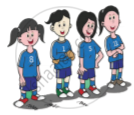
Write the events won by these players.
 |
______ |
 |
______ |
 |
______ |
Where did Kani see the old cracked cup?
What is the main idea of the text?
Divya and Rani decided to draw a ________.
Why did Manju’s parents leave the village?
Whose word are these? Name the character.
“I am not rich enough to buy this plate. This is a gold plate.”
What did Bala want to learn?
Does the child in the poem like her nose? Why do you think so?
The fir tree was sad ______.
What is the poem about?
What does the poet want us to do at night?
Why did the child in the poem like looking at the pictures?
