Advertisements
Advertisements
Question
Discuss the continuity of the following function at the point(s) or on the interval indicated against them:
f(x) = [x + 1] for x ∈ [−2, 2)
Where [*] is greatest integer function.
Advertisements
Solution
f(x) = [x + 1] ; x ∈ [−2, 2)
∴ f(x) `{:(= -1 , ";" x ∈ [−2"," -1)),(= 0, ";" x ∈ [−1"," 0)),(= 1, ";" x ∈ [0"," 1)),(= 2, ";" x ∈ [1 "," 2)):}`
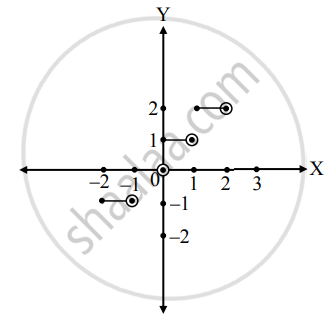
For continuity at x = – 1
`lim_(x -> -1^-) "f"(x) = lim_(x -> -1^-) [x + 1]`
`lim_(x -> -1^+) "f"(x) = lim_(x -> -1^+) [x + 1]`
∴ `lim_(x -> -1^-) "f"(x) = lim_(x -> -1^+) "f"(x)`
∴ f(x) is discontinuous at x = – 1
Similarly f(x) is discontinuous at
The points x = 0 and x = 1
APPEARS IN
RELATED QUESTIONS
Examine the continuity of f(x) = x3 + 2x2 − x − 2 at x = − 2
Examine whether the function is continuous at the points indicated against them:
f(x) `{:(= x^3 - 2x + 1",", "if" x ≤ 2),(= 3x - 2",", "if" x > 2):}}` at x = 2
Find all the point of discontinuities of f(x) = [x] on the interval (− 3, 2).
Discuss the continuity of the function f(x) = |2x + 3|, at x = `(−3)/(2)`
Test the continuity of the following function at the point or interval indicated against them :
f(x) `{:(= (sqrt(x - 1) - (x - 1)^(1/3))/(x - 2)",", "for" x ≠ 2),(= 1/5",", "for" x = 2):}}`at x = 2
Identify the discontinuity for the following function as either a jump or a removable discontinuity.
f(x) `{:(= x^2 + 3x - 2",", "for" x ≤ 4),(= 5x + 3",", "for" x > 4):}`
Discuss the continuity of the following function at the point indicated against them :
f(x) `{:(=(4^x - 2^(x + 1) + 1)/(1 - cos 2x)",", "for" x ≠ 0),(= (log 2)^2/2",", "for" x = 0):}}` at x = 0.
The following function has a removable discontinuity? If it has a removable discontinuity, redefine the function so that it become continuous :
f(x) `{:(= log_((1 + 3x)) (1 + 5x)",", "for" x > 0),(=(32^x - 1)/(8^x - 1)",", "for" x < 0):}}` at x = 0
The following function has a removable discontinuity? If it has a removable discontinuity, redefine the function so that it become continuous :
f(x) `{:(= 3x + 2",", "for" -4 ≤ x ≤-2),(= 2x - 3";", "for" -2 < x ≤ 6):}`
The following function has a removable discontinuity? If it has a removable discontinuity, redefine the function so that it become continuous :
f(x) `{:(= (x^3 - 8)/(x^2 - 4)",", "for" x > 2),(= 3",", "for" x = 2),(= ("e"^(3(x - 2)^2 - 1))/(2(x - 2)^2) ",", "for" x < 2):}`
If f(x) `{:(= (24^x - 8^x - 3^x + 1)/(12^x - 4^x - 3^x + 1)",", "for" x ≠ 0), (= "k"",", "for" x = 0):}}` is continuous at x = 0, find k
For what values of a and b is the function
f(x) `{:(= (x^2 - 4)/(x - 2)",", "for" x < 2),(= "a"x^2 - "b"x + 3",", "for" 2 ≤ x < 3),(= 2x - "a" + "b"",", "for" x ≥ 3):}}` continuous for every x on R?
Discuss the continuity of f(x) at x = `pi/4` where,
f(x) `{:(= ((sinx + cosx)^3 - 2sqrt(2))/(sin 2x - 1)",", "for" x ≠ pi/4),(= 3/sqrt(2)",", "for" x = pi/4):}`
Let f(x) = ax + b (where a and b are unknown)
= x2 + 5 for x ∈ R
Find the values of a and b, so that f(x) is continuous at x = 1
Select the correct answer from the given alternatives:
If f(x) = `((4 + 5x)/(4 - 7x))^(4/x)`, for x ≠ 0 and f(0) = k, is continuous at x = 0, then k is
Discuss the continuity of the following function at the point(s) or on the interval indicated against them:
f(x) `{:(= (x^2 - 3x - 10)/(x - 5)",", "for" 3 ≤ x ≤ 6"," x ≠ 5),(= 10",", "for" x = 5),(=(x^2 - 3x - 10)/(x - 5)",", "for" 6 < x ≤ 9):}`
Discuss the continuity of the following function at the point(s) or on the interval indicated against them:
f(x) `{:( = (sin^2pix)/(3(1 - x)^2) ",", "for" x ≠ 1),(= (pi^2sin^2((pix)/2))/(3 + 4cos^2 ((pix)/2)) ",", "for" x = 1):}}` at x = 1
Identify discontinuity for the following function as either a jump or a removable discontinuity on their respective domain:
f(x) `{:(= x^2 + 5x + 1"," , "for" 0 ≤ x ≤ 3),(= x^3 + x + 5"," , "for" 3 < x ≤ 6):}`
Find k if following function is continuous at the point indicated against them:
f(x) `{:(= (45^x - 9^x - 5^x + 1)/(("k"^x - 1)(3^x - 1))",", "for" x ≠ 0),(= 2/3",", "for" x = 0):}}` at x = 0
Find f(a), if f is continuous at x = a where,
f(x) = `(1 - cos[7(x - pi)])/(5(x - pi)^2`, for x ≠ π at a = π
If f(x) = `[tan (pi/4 + x)]^(1/x)`, x ≠ 0 at
= k, x = 0 is continuous x = 0. Then k = ______.
Let f : [-1, 2] → [0, ∞] be a continuous function such that f(x) = f(1 - x) ∀ x ∈ [-1, 2].
Let R1 = `int_-1^2 xf(x) dx` and R2 be the area of the region bounded by y = f(x), x = -1, x = 2 and the X-axis. Then, ______
If function `f(x)={((x^2-9)/(x-3), ",when "xne3),(k, ",when "x =3):}` is continuous at x = 3, then the value of k will be ______.
If f(x) = `{{:(tanx/x + secx",", x ≠ 0),(2",", x = 0):}`, then ______.
If f(x) = `{{:((sin5x)/(x^2 + 2x)",", x ≠ 0),(k + 1/2",", x = 0):}` is continuous at x = 0, then the value of k is ______.
For what value of k, the function defined by
f(x) = `{{:((log(1 + 2x)sin^0)/x^2",", "for" x ≠ 0),(k",", "for" x = 0):}`
is continuous at x = 0 ?
Which of the following is not continuous for all x?
For x > 0, `lim_(x rightarrow 0) ((sin x)^(1//x) + (1/x)^sinx)` is ______.
If f(x) = `{{:((sin^3(sqrt(3)).log(1 + 3x))/((tan^-1 sqrt(x))^2(e^(5sqrt(3)) - 1)x)",", x ≠ 0),( a",", x = 0):}`
is continuous in [0, 1] then a is equal to ______.
If \[\mathrm{f}(x)= \begin{cases} \mathrm{m}x+1, & x\leqslant\frac{\pi}{2} \\ \\ \mathrm{sin}x+\mathrm{n}, & x>\frac{\pi}{2} & \end{cases}\], is continuous at \[x=\frac{\pi}{2},( \begin{array} {c}\mathrm{m,n\in\mathbb{Z}} \end{array})\] then
Which condition defines continuity of a real-valued function \[f\] at \[x=c\]?
For which values is the constant function \[f(x)=k\] continuous?
Which statement about polynomial functions is correct?
For \[f(x)=x^2\], what verifies continuity at \[x=0\]?
