Advertisements
Advertisements
Question
Describe the mechanism of urine formation in human excretory system. Draw a labelled diagram to illustrate your answer.
Advertisements
Solution
Kidneys are the main excretory organ of the human body. There are about millions of nephron in each kidney. Each nephron contains a renal corpuscle and a renal tubule. The renal corpuscle consists of capillaries called the glomerulus, enclosed by a capsule called Bowman's capsule. The blood containing wastes (like urea) enters the glomerulus. The glomerulus filters the blood. During filtration, the filtrate (containing substances like glucose, amino acids, salts, water and urea) present in the blood travels through the renal tubule where materials needed by the body are reabsorbed, while the wastes like urea are collected and excreted in the urine. The nephron carries the urine into the collecting tubule of the kidney from where it is carried to the ureter. From the ureter, the urine passes into the urinary bladder. The urinary bladder stores the urine until it is forced out of the body, through an opening known as the urethra.

APPEARS IN
RELATED QUESTIONS
The kidneys in human beings are a part of the system for ______.
_____________ secreted by the (ii) _____________ lobe of the pituitary gland. If this hormone secretion is reduced, there is an increased production of urine. This disorder is called (iii) ____________. Sometimes excess glucose is passed with urine due to hyposecretion of another hormone called (iv) _____________ leading to the cause of a disease called (v) ______________.
The diagram given below shows a section of human kidney. Study the diagram carefully and answer the questions that follow :

(i) Label the parts numbered 1 to 4.
(ii) Why does part ‘2’ have a striped appearance?
(iii) What is the fluid that passes down part ‘4’? Name the main nitrogenous waste present in it.
(iv) Mention the structural and functional units of kidneys.
(v) Name the two major steps in the formation of the fluid mentioned in Q.5 (a) (iii).
Write the functions of the Urinary bladder
Where is the dirty blood in our body filtered?
Name the two parts of a plant through which its gaseous waste products are released into the air.
If a patient is out on dialysis, he is most likely suffering from a severe ailment of the:
(a) circulatory system
(b) respiratory system
(c) excretory system
(d) digestive system
Differentiate between
excretion and transpiration
One of the following sets of body parts or substances or processed, pick out the one item which overall includes the remaining foir.
Skin, liver, lungs, kidneys, excretion.
The following diagram represents a mammalian kidney tubule (nephron) and its blood supply.

Parts indicated by the guidelines 1 to 8 are as follows:
1. Afferent arteriole from renal artery
2. efferent arteriole
3. Bowman’s capsule
4. Glomerulus;
5. Proximal convoluted tubule with blood capillaries;
6. Distal convoluted tubule with blood capillaries;
7. collecting tubule;
8. U-shaped loop of Henle
Study the diagram and answer the question that follow:
Where does ultrafiltration take place?
Explain in your own words with suitable examples.
How is excretion in plants useful to human beings?
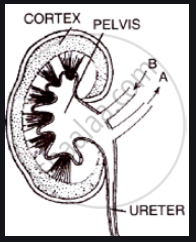
Given below is a highly simplified diagram of the human kidney cut open longitudinally. Answer the question that follow:
Mention two functions of the kidney.
Differentiate between:
Renal cortex and Renal medulla.
Draw a labeled diagram of the human kidney as seen in a longitudinal section.
Name the Following
The process by which kidneys regulate the water content of the body.
Choose the correct option.
In human beings, uric acid is formed due to metabolism of ______.
Choose the correct option.
What is micturition?
Answer the following question.
Amphibian tadpole can afford to be ammonotelic. Justify.
Answer the following question.
Birds are uricotelic in nature. Give reason.
Plants use completely different process for excretion as compared to animals. Which one of the following processes is NOT followed by plants for excretion?
