Advertisements
Advertisements
Question
The diagram given below shows a section of human kidney. Study the diagram carefully and answer the questions that follow :

(i) Label the parts numbered 1 to 4.
(ii) Why does part ‘2’ have a striped appearance?
(iii) What is the fluid that passes down part ‘4’? Name the main nitrogenous waste present in it.
(iv) Mention the structural and functional units of kidneys.
(v) Name the two major steps in the formation of the fluid mentioned in Q.5 (a) (iii).
Advertisements
Solution
(i)
1 – Cortex
2 – Medulla
3 – Pelvis
4 – Ureter
(ii) Medulla is composed of a striped substance arranged in several pyramids. Hence, the medulla (2) has a stripped appearance.
(iii) Urine passes down part ‘4’, i.e. ureter. The main nitrogenous substance present in it is urea.
(iv) Nephrons are the structural and functional units of the kidneys.
(v) The two major steps in the formation of urine are ultrafiltration and selective reabsorption.
APPEARS IN
RELATED QUESTIONS
Put a tick mark (✓) against the most appropriate alternative in the following statement :
In human beings, urea is produced in :
Define the following term :
Renal pelvis
The following diagram represents a mammalian kidney tubule (nephron) and its blood supply.
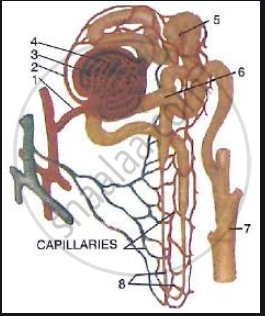
Parts indicated by the guidelines 1to 8 are as follows:
1. Afferent arteriole from renal artery
2. Efferent arteriole
3. Bowman's capsule
4. Glomerulus
5. Proximal convoluted tubule with blood capillaries
6. Distal convoluted tubule with blood capillaries
7. Collecting tubule
8. U-shaped loop of Henle
Study the diagram and answer the question that follow:
Which structure contains the highest concentration of urea?
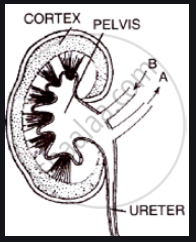
Given below is a highly simplified diagram of the human kidney cut open longitudinally. Answer the question that follow:
Mention two functions of the kidney.
Name the Following
The blood vessels which brings pure blood to the kidneys:
Choose the correct option.
In human beings, uric acid is formed due to metabolism of ______.
Choose the correct option.
Visceral layer : Podocytes :: PCT : ________.
Choose the correct option.
Deproteinised plasma is not found in ______.
Plants use completely different process for excretion as compared to animals. Which one of the following processes is NOT followed by plants for excretion?
Give two examples of the following:
Bile pigments
