Advertisements
Advertisements
Question
Answer the following question.
Birds are uricotelic in nature. Give reason.
Advertisements
Solution
- Birds are capable of converting ammonia into uric acid by ‘inosinic acid pathway’ in their liver.
- Uric acid is least toxic and hence, it can be retained in the body for some time.
- It is least soluble water hence, negligible amount of water is required for its elimination.
- This mode of excretion can also help reduce body weight (an adaptation for flight) and those animals which need to conserve more water follow uricotelism.
Hence, in order to conserve water as an adaptation for flight, birds are uricotelic in nature.
APPEARS IN
RELATED QUESTIONS
The diagram given below shows the male urinogenital system of a human being. Study the diagram and answer the questions that follow:

(i) Label the parts numbered 1 to 8.
(ii) Name the corresponding structure of part (4) in female reproductive system.
(iii) What is the role of part 7?
Tick the most appropriate answer.
The process of removing waste from the body is called
In summer the urine is slightly thicker than in winter explain the reason.
Given below is a diagram of a human kidney, cut open longitudinally. Answer the following:

(i) Give definition of excretion.
(ii) Name the unit of kidney.
(iii) Why does the cortex of kidney show dotted appearance?
(iv) List the functions of the kidney.
The following diagram represents a mammalian kidney tubule (nephron) and its blood supply.
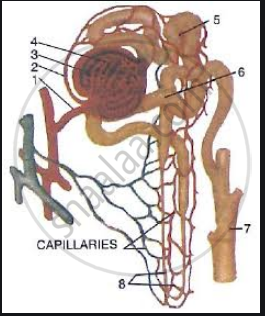
Parts indicated by the guidelines 1to 8 are as follows:
1. Afferent arteriole from renal artery
2. Efferent arteriole
3. Bowman's capsule
4. Glomerulus
5. Proximal convoluted tubule with blood capillaries
6. Distal convoluted tubule with blood capillaries
7. Collecting tubule
8. U-shaped loop of Henle
Study the diagram and answer the question that follow:
Where is most water reabsorbed ?
Give Technical Term:
The organ in man concerned with maintaining water balance in the body.
Write the functional activity of the following structure: Vasopressin
Choose the Odd One Out:
When uric acid is produced in excess, it gets deposited in joints, resulting in ____________.
The main nitrogenous waste formed in the human body:
