Advertisements
Advertisements
Question
Where is urine carried through ureters?
Advertisements
Solution
Urine is carried into the urinary bladder through two narrow tubes that are called ureters.
APPEARS IN
RELATED QUESTIONS
Why is it necessary to excrete waste products?
Name a waste gas released by the plants only during the daytime.
What does the bladder in our body do?
Explain the principle of dialysis with the help of a labelled diagram.
In which of the following are the largest amounts of nitrogen excreted from a mammalian body?
(a) breath
(b) sweat
(c) urine
(d) faeces
Answer the following in detail.
Describe the process of urine formation.
One of the following sets of body parts or substances or processed, pick out the one item which overall includes the remaining foir.
Skin, liver, lungs, kidneys, excretion.
Write down the functional activity of the following parts,
Renal artery ………………
Explain the difference between the excretory system of humans and plants.
Choose the correct answer:
The smallest functional unit of the kidney is ____________
Given below is a diagram of a human kidney, cut open longitudinally. Answer the following:

(i) Give definition of excretion.
(ii) Name the unit of kidney.
(iii) Why does the cortex of kidney show dotted appearance?
(iv) List the functions of the kidney.
The following diagram represents a mammalian kidney tubule (nephron) and its blood supply.
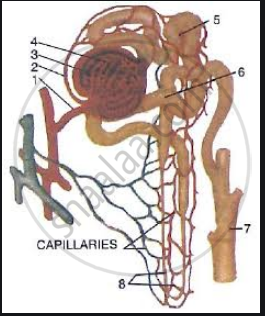
Parts indicated by the guidelines 1to 8 are as follows:
1. Afferent arteriole from renal artery
2. Efferent arteriole
3. Bowman's capsule
4. Glomerulus
5. Proximal convoluted tubule with blood capillaries
6. Distal convoluted tubule with blood capillaries
7. Collecting tubule
8. U-shaped loop of Henle
Study the diagram and answer the question that follow:
Which structure (normally) contains the lowest concentration of glucose?
Study the diagram given alongside and then answer the question that follow:
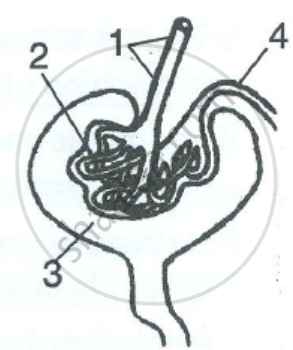
Name the parts labelled 1, 2, 3, and 4.
Name the Following
The blood vessels which brings pure blood to the kidneys:
Complete the following sentence with appropriate word:
______ supplies blood to kidney.
Write the functional activity of the following structure: Aldosterone
Write the functional activity of the following structure: Henle’s loop
Two green plants are kept separately in oxygen-free containers, one in the dark and the other in continuous light. Which one will live longer? Give reasons.
Certain organisms that are aquatic in habitat, tolerate only a narrow range of salinity. What term is given to such animals?
Identify the correct labels for A and B in the following diagram

