Advertisements
Advertisements
Question
The following diagram represents a mammalian kidney tubule (nephron) and its blood supply.
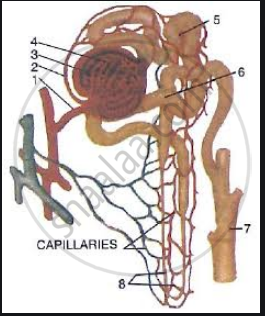
Parts indicated by the guidelines 1to 8 are as follows:
1. Afferent arteriole from renal artery
2. Efferent arteriole
3. Bowman's capsule
4. Glomerulus
5. Proximal convoluted tubule with blood capillaries
6. Distal convoluted tubule with blood capillaries
7. Collecting tubule
8. U-shaped loop of Henle
Study the diagram and answer the question that follow:
Which structure (normally) contains the lowest concentration of glucose?
Advertisements
Solution
7/ Collecting tubule
RELATED QUESTIONS
How is the amount of urine produced regulated?
Correct the statement by changing the underlined word.
Normal pale colour of the urine is due to the presence of the pigment Melanin.
Fill in the blank.
....................... are present in the stem of pine tree that make the pinewood strong and durable.
Fill in the blanks in the following passage to make it a meaningful description.
In a nephron, the ______ flows through the ______ under great pressure. The reason for this great pressure is that the ______ (outgoing) ______ is narrower than the ______ (incoming). This high pressure causes the ______ part of the blood to filter out from the ______ into the ______ capsule.
The following diagram represents a mammalian kidney tubule (nephron) and its blood supply.
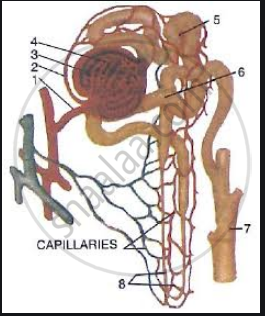
Parts indicated by the guidelines 1to 8 are as follows:
1. Afferent arteriole from renal artery
2. Efferent arteriole
3. Bowman's capsule
4. Glomerulus
5. Proximal convoluted tubule with blood capillaries
6. Distal convoluted tubule with blood capillaries
7. Collecting tubule
8. U-shaped loop of Henle
Study the diagram and answer the question that follow:
Where is most water reabsorbed ?
Study the diagram given alongside and then answer the question that follow:
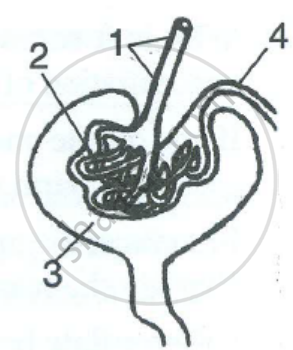
Name the stages involved in the formation of urine.
Complete the following sentence with appropriate word:
The U-shaped portion of a nephron located in the medulla region is called ______.
Write the functional activity of the following structure: Renal artery
Why is the rate of breathing in aquatic organisms much faster than in terrestrial organisms?
Give two examples of the following:
Water-soluble vitamins
