Advertisements
Advertisements
प्रश्न
The following diagram represents a mammalian kidney tubule (nephron) and its blood supply.
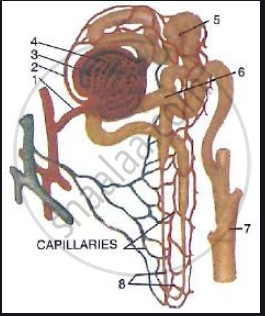
Parts indicated by the guidelines 1to 8 are as follows:
1. Afferent arteriole from renal artery
2. Efferent arteriole
3. Bowman's capsule
4. Glomerulus
5. Proximal convoluted tubule with blood capillaries
6. Distal convoluted tubule with blood capillaries
7. Collecting tubule
8. U-shaped loop of Henle
Study the diagram and answer the question that follow:
Which structure (normally) contains the lowest concentration of glucose?
Advertisements
उत्तर
7/ Collecting tubule
संबंधित प्रश्न
How is the amount of urine produced regulated?
State the exact location of the Loop of Henle.
The given diagram represents a nephron and its blood supply. Study the diagram and answer the following questions:

(i) Label parts 1, 2, 3 and 4.
(ii) State the reason for the high hydrostatic pressure in the glomerulus.
(iii) Name the blood vessel which contains the least amount of urea in this diagram.
(iv) Name the two main stages of urine formation.
(v) Name the part of the nephron which lies in the renal medulla.
Differentiate between
tannins and resins
Choose the odd one out in the following serie:
Column of Bertini, minora calyces, brain.
Answer the following question:
Explain the human excretory system with the help of a suitable diagram.
Hypotonic filtrate is formed in _______.
Choose the correct option.
The part of nephron which absorbs glucose and amino acid is ______.
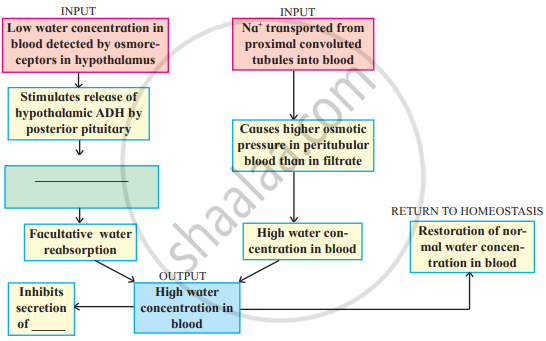
Complete the diagram/chart with correct labels/ information. Write the conceptual details regarding it.