Advertisements
Advertisements
प्रश्न
Describe the mechanism of urine formation in human excretory system. Draw a labelled diagram to illustrate your answer.
Advertisements
उत्तर
Kidneys are the main excretory organ of the human body. There are about millions of nephron in each kidney. Each nephron contains a renal corpuscle and a renal tubule. The renal corpuscle consists of capillaries called the glomerulus, enclosed by a capsule called Bowman's capsule. The blood containing wastes (like urea) enters the glomerulus. The glomerulus filters the blood. During filtration, the filtrate (containing substances like glucose, amino acids, salts, water and urea) present in the blood travels through the renal tubule where materials needed by the body are reabsorbed, while the wastes like urea are collected and excreted in the urine. The nephron carries the urine into the collecting tubule of the kidney from where it is carried to the ureter. From the ureter, the urine passes into the urinary bladder. The urinary bladder stores the urine until it is forced out of the body, through an opening known as the urethra.

APPEARS IN
संबंधित प्रश्न
The kidneys in human beings are a part of the system for ______.
Match structures given in Column I with functions given in Column II.
| Column I | Column II | ||
| (i) | Stomata | (a) | Absorption of water |
| (ii) | Xylem | (b) | Transpiration |
| (iii) | Root hairs | (c) | Transport of food |
| (iv) | Phloem | (d) | Transport of water |
| (e) | Synthesis of carbohydrates |
the biological/technical terms for the hormone increasing reabsorption of water by kidney tubules
The given diagram represents a nephron and its blood supply. Study the diagram and answer the following questions:

(i) Label parts 1, 2, 3 and 4.
(ii) State the reason for the high hydrostatic pressure in the glomerulus.
(iii) Name the blood vessel which contains the least amount of urea in this diagram.
(iv) Name the two main stages of urine formation.
(v) Name the part of the nephron which lies in the renal medulla.
Fill in the following blank with suitable word:
Gums and resins are the .......... products of plants.
Define excretion. Name the excretory unit of a kidney.
A dialysis machine contains long tubes coiled in a tank containing dialysing solution
What does the dialysing solution contain?
Name the various organs of the human excretory system.
Where is urine carried through ureters?
Given below is a set of five terms. Rewrite the terms in their correct order so as to be in logical sequence.
Afferent arteriole, renal vein, secondary capillary network, glomerulus, efferent arteriole.
Write down the functional activity of the following parts,
Renal artery ………………
Fill in the blanks in the following passage to make it a meaningful description.
In a nephron, the ______ flows through the ______ under great pressure. The reason for this great pressure is that the ______ (outgoing) ______ is narrower than the ______ (incoming). This high pressure causes the ______ part of the blood to filter out from the ______ into the ______ capsule.
Correct and rewrite the statements by changing the biological term that is underlined for the statement:
The kidney is composed of number of neurons.
Choose the odd one out in the following serie:
Column of Bertini, minora calyces, brain.
The following diagram represents a mammalian kidney tubule (nephron) and its blood supply.
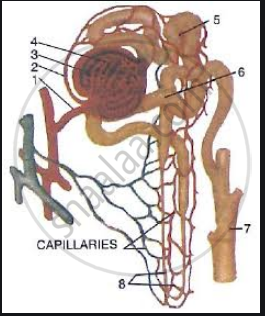
Parts indicated by the guidelines 1to 8 are as follows:
1. Afferent arteriole from renal artery
2. Efferent arteriole
3. Bowman's capsule
4. Glomerulus
5. Proximal convoluted tubule with blood capillaries
6. Distal convoluted tubule with blood capillaries
7. Collecting tubule
8. U-shaped loop of Henle
Study the diagram and answer the question that follow:
Where is most water reabsorbed ?
Choose the Odd One Out:
Choose the Odd One Out:
Choose the correct option.
What is micturition?
The product of the process of deamination is ______.
Plants use completely different process for excretion as compared to animals. Which one of the following processes is NOT followed by plants for excretion?
