Advertisements
Advertisements
Question
If a patient is out on dialysis, he is most likely suffering from a severe ailment of the:
(a) circulatory system
(b) respiratory system
(c) excretory system
(d) digestive system
Advertisements
Solution
(c) excretory system
Dialysis is the process of removing wastes using an artificial kidney. Hence, if a patient is out on dialysis, he is most likely suffering from a severe ailment of excretory system. It is because kidneys are a part of human excretory system and in case of kidney failure, to remove the accumulated wastes from the body, blood is filtered periodically through an artificial kidney.
APPEARS IN
RELATED QUESTIONS
Draw a diagram of the human excretory system and label the various parts.
The diagram given below shows a section of human kidney. Study the diagram carefully and answer the questions that follow :

(i) Label the parts numbered 1 to 4.
(ii) Why does part ‘2’ have a striped appearance?
(iii) What is the fluid that passes down part ‘4’? Name the main nitrogenous waste present in it.
(iv) Mention the structural and functional units of kidneys.
(v) Name the two major steps in the formation of the fluid mentioned in Q.5 (a) (iii).
Define excretion.
The diagram given below is that of a structure present in a human kidney.
Study the same and answer the questions that follow:

1) Name the structure represented in the diagram
2) What is the liquid entering part ‘1’ called?
Name two substances present in this liquid that are reabsorbed in the tubule.
3) What is the fluid that comes to part ‘2’ called?
Name the main nitrogenous waste in it.
4) Mention the three main steps involved in the formation of the fluid mentioned in (iii) above
5) Name the substance which may be present in the fluid in part ‘2’ if a person suffers from Diabetes mellitus.
Write True (T) or False (F) for the following statement. Rewrite the false statement in the correct form.
Urine is devoid of blood cells.
Answer the following in detail.
Describe the process of urine formation.
Differentiate between the following pairs of terms:
Bowman’s capsule and malpighian capsule.
Choose the odd one out in the following series:
Proximal convoluted duct, loop of Henle, vein.
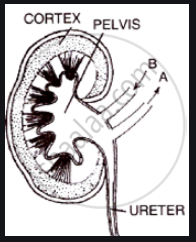
Given below is a highly simplified diagram of the human kidney cut open longitudinally. Answer the question that follow:
Write two differences in composition of the blood flowing through the blood vessels, 'A' and 'B'.
Study the diagram given alongside and then answer the question that follow:
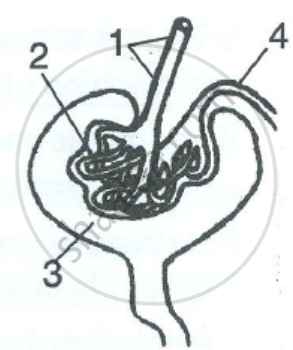
Name the parts labelled 1, 2, 3, and 4.
Describe in brief how urine is produced in the human body.
Name the Following
The term used for Bowman’s capsule and glomerulus together.
Name the Following
The branch of renal artery which enters into Bowman’s capsule.
Complete the following sentence with appropriate word:
______ is the functional unit of kidney.
Write the functional activity of the following structure: Aldosterone
Write the functional activity of the following structure: Henle’s loop
Identify the INCORRECT match.
Osmoregulation maintains the osmolarity of blood at about ______.
In order to maintain homeostasis or constant internal environment . ______' is essential.
An organ that produces urea:
