Advertisements
Advertisements
Question
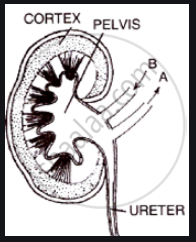
Given below is a highly simplified diagram of the human kidney cut open longitudinally. Answer the question that follow:
Write two differences in composition of the blood flowing through the blood vessels, 'A' and 'B'.
Advertisements
Solution
The blood vessel 'B' is renal artery and the blood vessel 'A' is renal vein.
So the blood vessel 'B' contains oxygenated blood with high concentration of urea and glucose whereas the blood vessel 'A' contains deoxygenated blood with low concentration of urea and glucose as compared to renal artery.
RELATED QUESTIONS
Why do some people need to use a dialysis machine? What does the machine do?
Name the following:
The tuft of capillaries inside the Bowman's capsule.
Given below is a highly simplified diagram of the human kidney cut open longitudinally. Answer the question that follow:
Why does the cortex of the kidney show a dotted appearance?

Choose the Odd One Out:
Choose the correct option.
Visceral layer : Podocytes :: PCT : ________.
Choose the correct option.
Deproteinised plasma is not found in ______.
Bilirubin and Biliverdin are pigments which are ____________.
Elimination of nitrogenous wastes in the form of uric acid takes place in ____________.
“All plants give out oxygen during the day and carbon dioxide during the night”. Do you agree with this statement? Give a reason.
Give two examples of the following:
Water-soluble vitamins
