Advertisements
Advertisements
प्रश्न
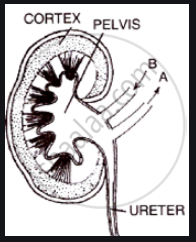
Given below is a highly simplified diagram of the human kidney cut open longitudinally. Answer the question that follow:
Write two differences in composition of the blood flowing through the blood vessels, 'A' and 'B'.
Advertisements
उत्तर
The blood vessel 'B' is renal artery and the blood vessel 'A' is renal vein.
So the blood vessel 'B' contains oxygenated blood with high concentration of urea and glucose whereas the blood vessel 'A' contains deoxygenated blood with low concentration of urea and glucose as compared to renal artery.
संबंधित प्रश्न
Why do some people need to use a dialysis machine? What does the machine do?
Fill in the blank.
.................. produces bile pigments from the heamoglobin of broken RBCs.
If you donate one kidney to a needy patient, would it cause any harm to you? Give reason.
Choose the correct answer:
What happens if one kidney is removed from the body of human being?
The following diagram represents a mammalian kidney tubule (nephron) and its blood supply.
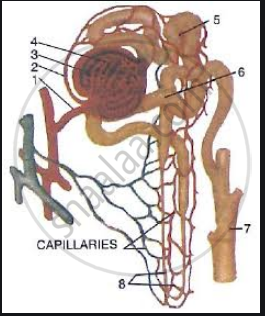
Parts indicated by the guidelines 1to 8 are as follows:
1. Afferent arteriole from renal artery
2. Efferent arteriole
3. Bowman's capsule
4. Glomerulus
5. Proximal convoluted tubule with blood capillaries
6. Distal convoluted tubule with blood capillaries
7. Collecting tubule
8. U-shaped loop of Henle
Study the diagram and answer the question that follow:
Where is most water reabsorbed ?
Study the diagram given below and then answer the questions that follow:
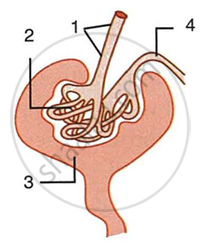 |
- Name the region in the kidney where the above structure is present?
- Name the parts labelled 1, 2, 3 and 4.
- Name the stages involved in the formation of urine.
- What is the technical term given to the process occurring in 2 and 3? Briefly describe the process.
The diagram below represents a mammalian kidney tubule (nephron) and its blood supply. Parts indicated by the guidelines 1 to 8 are as follows:
1. U-shaped loop of Henle
2. Proximal convoluted tubule with blood capillaries
3. Bowman’s capsule
4. Afferent arteriole from the renal artery
5. Glomerulus
6. Venule to the renal vein
7. Collecting tubule
8. Distal convoluted tubule with blood capillaries Study the diagram and answer the following questions in each case:
(i) Where does ultrafiltration take place?
(ii) Which structure contains the lowest concentration of urea?
(iii) Which structure contains the highest concentration of urea?
(iv) Which structure contains the lowest concentration of glucose?
(v) Where is the most water reabsorbed?
Draw a labeled diagram of the human kidney as seen in a longitudinal section.
Give Technical Terms
The hormone that helps increase the reabsorption of water from the kidney tubules.
Plants use completely different process for excretion as compared to animals. Which one of the following processes is NOT followed by plants for excretion?
