Advertisements
Advertisements
प्रश्न
Advertisements
उत्तर
Nephron is the basic structural and functional unit of the kidney.
Its chief function is to regulate the concentration of water and soluble substances like sodium salts by filtering the blood, reabsorbing what is needed and excreting the rest as urine.
APPEARS IN
संबंधित प्रश्न
How is the amount of urine produced regulated?
Define excretion.
Define excretion.
Where is urine carried through ureters?
Write True (T) or False (F) for the following statement. Rewrite the false statement in the correct form.
Excess sugar in the blood is a symptom of diabetes.
Write down the functional activity of the following parts,
Renal artery ………………
Given below is a simple diagram of the human kidney cut open longitudinally. Answer the following questions: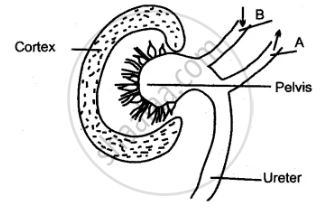
c
(v) Write two differences in the composition of the blood flowing through blood vessels A and B.
Choose the Odd One Out:
Osmoregulation maintains the osmolarity of blood at about ______.
In a person the tubule part of the nephron is not functioning at all. What will its effect be on urine formation?
