Advertisements
Advertisements
प्रश्न
Answer the following in detail.
Describe the process of urine formation.
Advertisements
उत्तर
The process of urine formation takes place in the following steps:
- Glomerular Alteration: Blood containing waste material enters the kidneys through the renal artery. It then enters the glomerulus under high pressure. Water and small solutes are filtered in the Bowman’s capsule.
- Tubular reabsorption: Filterate passes through the thin walls of the Bowman’s capsule into the urinary or renal tubule. As it passes through the tubule, water, and many useful substances are reabsorbed by the renal blood capillaries.
- Tubular secretion: The remaining liquid, along with wastes such as urea, uric acid, etc., is called urine and is collected in the urinary bladder.
- Excretion: Urine leaves the kidneys and passes into the urinary bladder through the ureters. When the urinary bladder is full, urine is passed out through the urethra.
APPEARS IN
संबंधित प्रश्न
Explain Selective reabsorption
In which of the following are the largest amounts of nitrogen excreted from a mammalian body?
Differentiate between
excretion and transpiration
Choose the odd one out in the following serie:
Column of Bertini, minora calyces, brain.
Differentiate between:
Ureter and Urethra.
Study the diagram given below and then answer the questions that follow:
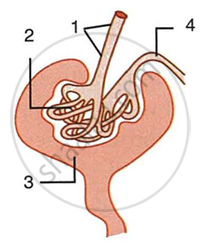 |
- Name the region in the kidney where the above structure is present?
- Name the parts labelled 1, 2, 3 and 4.
- Name the stages involved in the formation of urine.
- What is the technical term given to the process occurring in 2 and 3? Briefly describe the process.
Complete the following sentence with appropriate word:
The sum total of all the chemical reactions taking place in the cell is known as ______.
Choose the Odd One Out:
Choose the correct option.
Which one of the following organisms excrete waste through nephridia?
Osmoregulation maintains the osmolarity of blood at about ______.
