Advertisements
Advertisements
प्रश्न
Differentiate between
excretion and transpiration
Advertisements
उत्तर
| Excretion | Transpiration | ||
| 1 | It is the process of removing or getting rid of waste matter from the body. | 1 | It is the process of losing excess water from aerial plant parts in the form of water vapour. |
| 2 | Excretion rate is independent of the time of the day. | 2 | The rate of transpiration is more during the day. |
| 3 | All living beings have special organs called excretory organs to get rid of their harmful wastes. | 3 | Plants lose water through stomata and lenticels. |
| 4 | It occurs both in plants and animals. | 4 | It occurs only in plants. |
APPEARS IN
संबंधित प्रश्न
Mention the exact location of the Prostate gland.
Name the two parts of a plant through which its gaseous waste products are released into the air.
Fill in the blank.
Malpighian body consists of Bowman’s capsule and .....................
Explain in your own words with suitable examples.
How does excretion occur in human beings?
Choose the odd one out in the following serie:
Column of Bertini, minora calyces, brain.
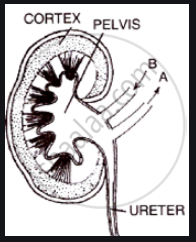
Given below is a highly simplified diagram of the human kidney cut open longitudinally. Answer the question that follow:
Write two differences in composition of the blood flowing through the blood vessels, 'A' and 'B'.
Explain the Term: Glomerulus
Answer the following question.
Why do we get bad breath after eating garlic or raw onion?
Answer the following question.
Amphibian tadpole can afford to be ammonotelic. Justify.
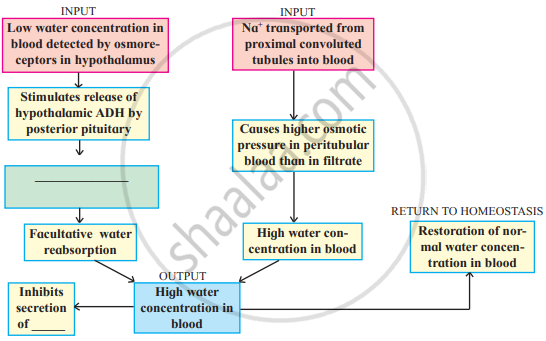
Complete the diagram/chart with correct labels/ information. Write the conceptual details regarding it.