Advertisements
Advertisements
प्रश्न
Explain in your own words with suitable examples.
How does excretion occur in human beings?
Advertisements
उत्तर
- The excretory system removes wastes from the body, which is an important function.
- The human excretory system is made up of two kidneys, two ureters, the urine bladder, and the urethra. The kidneys produce urine by removing waste and undesirable chemicals from the bloodstream.
- Nephrons are the functional units of the kidney that perform the basic function of filtration. The urea generated in the liver enters the bloodstream.
- When urea-containing blood enters the glomerulus, it is filtered by capillaries, removing urea and other related compounds.
- Water molecules and tiny molecules of other substances can pass through the semipermeable membrane of Bowman's capsule.
- The fluid that has accumulated in the Bowman's capsule cavity enters the nephron's tubular portion. Here, water molecules and other important compounds are reabsorbed into the bloodstream.
- Urine is generated from the residual fluid, which contains waste elements. The ureters carry urine, which is then stored in the urinary bladder. Urine is then released through the urethra.
APPEARS IN
संबंधित प्रश्न
_____________ secreted by the (ii) _____________ lobe of the pituitary gland. If this hormone secretion is reduced, there is an increased production of urine. This disorder is called (iii) ____________. Sometimes excess glucose is passed with urine due to hyposecretion of another hormone called (iv) _____________ leading to the cause of a disease called (v) ______________.
The Biological/technical term for The removal of nitrogenous wastes from the body
Differentiate between the following pair on the basis of what is indicated in the bracket.
Ureter and Urethra [function]
Name an animal which absorbs oxygen through its moist skin.
What are the methods used by plants to get rid of their waste products?
If a patient is out on dialysis, he is most likely suffering from a severe ailment of the ______.
Fill in the blank :
Nitrogenous wastes in the urine are in the form of urea and .....................
What is dialysis? Under what condition is it carried out?
Study the diagram given alongside and then answer the question that follow:
Name the region in the kidney where the above structure is present?
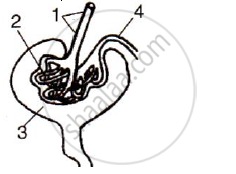
Explain the difference between the excretory system of humans and plants.
Choose the correct answer:
Composition of extracellular fluid is regulated by ___________
Given below is a highly simplified diagram of the human kidney cut open longitudinally. Answer the question that follow:
Name the functional units of the kidneys.
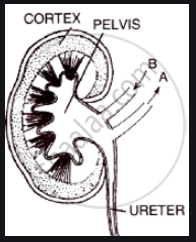
Study the diagram given alongside and then answer the question that follow:
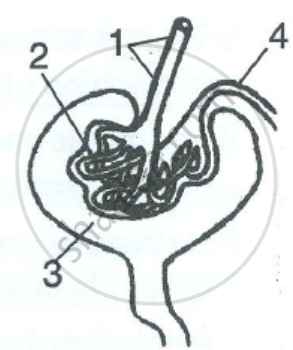
Name the parts labelled 1, 2, 3, and 4.
The diagram below represents a mammalian kidney tubule (nephron) and its blood supply. Parts indicated by the guidelines 1 to 8 are as follows:
1. U-shaped loop of Henle
2. Proximal convoluted tubule with blood capillaries
3. Bowman’s capsule
4. Afferent arteriole from the renal artery
5. Glomerulus
6. Venule to the renal vein
7. Collecting tubule
8. Distal convoluted tubule with blood capillaries Study the diagram and answer the following questions in each case:
(i) Where does ultrafiltration take place?
(ii) Which structure contains the lowest concentration of urea?
(iii) Which structure contains the highest concentration of urea?
(iv) Which structure contains the lowest concentration of glucose?
(v) Where is the most water reabsorbed?
Complete the following sentence with appropriate word:
The U-shaped portion of a nephron located in the medulla region is called ______.
Choose the correct option.
Specific gravity of urine would _______ if level of ADH increases.
Answer the following question.
Birds are uricotelic in nature. Give reason.
Give two examples of the following:
Main excretory organs
The statement given below is false. Rewrite the correct form of the statement by changing the underlined word.
The pigment urochrome is the breakdown product of the haemoglobin of dead RBCs.
Give reason:
Excretion is a necessary process of our body.
