Advertisements
Advertisements
प्रश्न
Match structures given in Column I with functions given in Column II.
| Column I | Column II | ||
| (i) | Stomata | (a) | Absorption of water |
| (ii) | Xylem | (b) | Transpiration |
| (iii) | Root hairs | (c) | Transport of food |
| (iv) | Phloem | (d) | Transport of water |
| (e) | Synthesis of carbohydrates |
Advertisements
उत्तर
| Column I | Column II | ||
| (i) | Stomata | (b) | Transpiration |
| (ii) | Xylem | (d) | Transport of water |
| (iii) | Root hairs | (a) | Absorption of water |
| (iv) | Phloem | (c) | Transport of food |
APPEARS IN
संबंधित प्रश्न
Identify the odd one.
The diagram given alongside is that of a structure present in a human kidney:
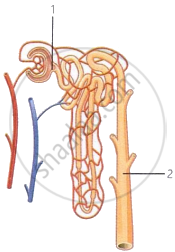
Study the same and answer the questions that follow:
- Name the structure represented in the diagram.
- What is the liquid entering part ‘1’ called?
Name two substances present in this liquid that are reabsorbed in the tubule - What is the fluid that comes to part ‘2’ called? Name the main nitrogenous waste in it.
- Mention the three main steps involved in the formation of the fluid mentioned in (c) above.
- Name the substance which may be present in the fluid in part ‘2’ if a person suffers from Diabetes mellitus
Where is the dirty blood in our body filtered?
Draw a neat labelled diagram of the human excretory system.
Answer the following in short.
List five waste products of plants.
Name the following:
The part of kidney tubules where the term urine is first used for the fluid in it.
Answer the following question.
Why do we get bad breath after eating garlic or raw onion?
Give two examples of the following:
Nitrogenous waste
An organ that produces urea:
The statement given below is false. Rewrite the correct form of the statement by changing the underlined word.
The pigment urochrome is the breakdown product of the haemoglobin of dead RBCs.
