Advertisements
Advertisements
Question
Match structures given in Column I with functions given in Column II.
| Column I | Column II | ||
| (i) | Stomata | (a) | Absorption of water |
| (ii) | Xylem | (b) | Transpiration |
| (iii) | Root hairs | (c) | Transport of food |
| (iv) | Phloem | (d) | Transport of water |
| (e) | Synthesis of carbohydrates |
Advertisements
Solution
| Column I | Column II | ||
| (i) | Stomata | (b) | Transpiration |
| (ii) | Xylem | (d) | Transport of water |
| (iii) | Root hairs | (a) | Absorption of water |
| (iv) | Phloem | (c) | Transport of food |
APPEARS IN
RELATED QUESTIONS
Name the basic filtration unit present in the kidney.
What does the bladder in our body do?
Describe the mechanism of urine formation in human excretory system. Draw a labelled diagram to illustrate your answer.
Write down the functional activity of the following parts,
Henle's loop ………………
Given below is a simplified diagram of the human kidney cut open longitudinally. Answer the questions that follow.
 |
- Define excretion.
- Why does the cortex of the kidney show a dotted appearance?
- Why does the medulla of the kidney show a striped appearance?
- Write two differences in the composition of the blood flowing through the blood vessels 'A' and 'B'.
Correct and rewrite the statement by changing the biological term that is underlined for the statement:
The kidney is composed of number of neurons.
Name the following:
Functional unit of kidney.
The following diagram represents a mammalian kidney tubule (nephron) and its blood supply.
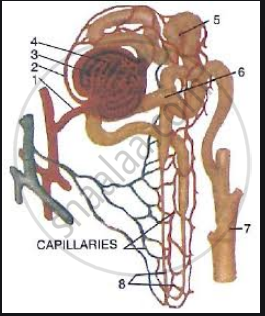
Parts indicated by the guidelines 1to 8 are as follows:
1. Afferent arteriole from renal artery
2. Efferent arteriole
3. Bowman's capsule
4. Glomerulus
5. Proximal convoluted tubule with blood capillaries
6. Distal convoluted tubule with blood capillaries
7. Collecting tubule
8. U-shaped loop of Henle
Study the diagram and answer the question that follow:
Which structure contains the lowest concentration of urea?
Adult frog is an amphibian, its mode of excretion is ______.
Why is the rate of breathing in aquatic organisms much faster than in terrestrial organisms?
