Advertisements
Advertisements
प्रश्न
Answer the following question.
Amphibian tadpole can afford to be ammonotelic. Justify.
Advertisements
उत्तर
- Tadpole (larval stage of life cycle of amphibian) is aquatic. They are ammonotelic as they excrete nitrogenous waste in the form of ammonia.
- Ammonia is very toxic and requires large amount of water for its elimination.
- It is readily soluble in water and diffuses across the body surface and into the surrounding water.
- Also, the water lost during excretion can be made up through the surrounding water in ammonotelic organisms.
Hence, amphibian tadpole can afford to be ammonotelic.
APPEARS IN
संबंधित प्रश्न
Differentiate between the following pair on the basis of what is indicated in the bracket.
Ureter and Urethra [function]
What gaseous waste products are excreted by plants?
Name the following:
The outer region of kidney containing the Bowman's capsule.
In summer the urine is slightly thicker than in winter explain the reason.
The following diagram represents a mammalian kidney tubule (nephron) and its blood supply.
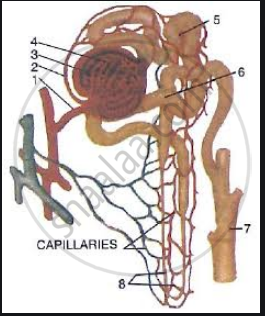
Parts indicated by the guidelines 1to 8 are as follows:
1. Afferent arteriole from renal artery
2. Efferent arteriole
3. Bowman's capsule
4. Glomerulus
5. Proximal convoluted tubule with blood capillaries
6. Distal convoluted tubule with blood capillaries
7. Collecting tubule
8. U-shaped loop of Henle
Study the diagram and answer the question that follow:
Which structure (normally) contains the lowest concentration of glucose?
Name the Following
The term used for Bowman’s capsule and glomerulus together.
Hypotonic filtrate is formed in _______.
In order to maintain homeostasis or constant internal environment . ______' is essential.
In a person the tubule part of the nephron is not functioning at all. What will its effect be on urine formation?
Salt excreting glands are found near ______ in marine birds like Albatross.
