Advertisements
Advertisements
प्रश्न
Answer the following question.
John has two options as a treatment for his renal problem: Dialysis or kidney transplants. Which option should he choose? Why?
Advertisements
उत्तर
- If John has two options of dialysis and kidney transplant, readily available he must opt for kidney transplant.
- A kidney transplant, if successful, can improve the quality of life of a patient and reduce the risk of death.
- The patient would not have to endure frequent dialysis procedures. Repeated visits for dialysis takes time and may not allow the patient to perform normal activities or go to office regularly.
- Dialysis is regarded as a holding measure until kidney transplant can be performed or a supportive measure in those for whom a transplant would be inappropriate. However, dialysis cannot replace all the functions of a normal kidney such as production of hormones like erythropoietin, calcitriol and renin. Hence, if John has an option of kidney transplant, he must opt for it.
APPEARS IN
संबंधित प्रश्न
Write True (T) or False (F) for the following statement. Rewrite the false statement in the correct form.
Removal of solid undigested food is excretion
What are the two ways by which a person can get relief in case of kidney failure?
Draw a diagram of the human excretory system and label the following parts: Kidney, ureter, urinary bladder, and urethra.
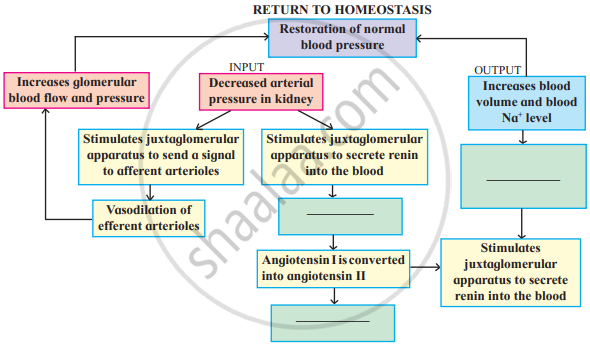
Complete the diagram/chart with correct labels/ information. Write the conceptual details regarding it.
In acute renal failure the urine output decreases. This condition is called ____________.
Dialysis is an imperfect treatment because ______
Match the abnormal conditions given in Column A with their explanations given in Column B and Choose the correct option
| Column A | Column B |
| A. Glycosuria | i. Accumulation of uric acid in joints |
| B. Renal calculi | ii. Inflammation in glomeruli |
| C. Glomerular nephritis | iii. Mass of crystallised salts within the kidney |
| D. Gout | iv. Presence of glucose in urine |
Which statement is correct regarding the haemodialysis procedure?
Presence of which of the following conditions in urine are indicative of diabetes mellitus?
Which one of the following is CORRECT regarding struvite stones in kidney?
I. These are formed in response to bacterial infection.
II. It is a genetic disorder.
III. These grow quickly and become quite large.
IV. Occurs in people who consume a high-protein diet.
V. Affected people excrete too much of certain amino acid.
