Advertisements
Advertisements
प्रश्न
Differentiate between
excretion and transpiration
Advertisements
उत्तर
| Excretion | Transpiration | ||
| 1 | It is the process of removing or getting rid of waste matter from the body. | 1 | It is the process of losing excess water from aerial plant parts in the form of water vapour. |
| 2 | Excretion rate is independent of the time of the day. | 2 | The rate of transpiration is more during the day. |
| 3 | All living beings have special organs called excretory organs to get rid of their harmful wastes. | 3 | Plants lose water through stomata and lenticels. |
| 4 | It occurs both in plants and animals. | 4 | It occurs only in plants. |
APPEARS IN
संबंधित प्रश्न
Explain the term haemodialysis.
Write the functions of Kidney
The diagram given alongside is that of a structure present in a human kidney:
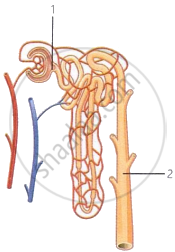
Study the same and answer the questions that follow:
- Name the structure represented in the diagram.
- What is the liquid entering part ‘1’ called?
Name two substances present in this liquid that are reabsorbed in the tubule - What is the fluid that comes to part ‘2’ called? Name the main nitrogenous waste in it.
- Mention the three main steps involved in the formation of the fluid mentioned in (c) above.
- Name the substance which may be present in the fluid in part ‘2’ if a person suffers from Diabetes mellitus
What gaseous waste products are excreted by plants?
Write True (T) or False (F) for the following statement. Rewrite the false statement in the correct form.
Excess sugar in the blood is a symptom of diabetes.
Name the following:
The outer region of kidney containing the Bowman's capsule.
Answer the following question:
Explain the human excretory system with the help of a suitable diagram.
Complete the following sentence with appropriate word:
______ is the functional unit of kidney.
Write the functional activity of the following structure: Henle’s loop
Answer the following question.
Why do we get bad breath after eating garlic or raw onion?
