Advertisements
Advertisements
प्रश्न
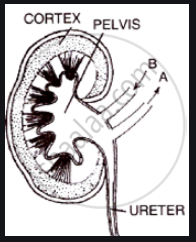
Given below is a highly simplified diagram of the human kidney cut open longitudinally. Answer the question that follow:
Write two differences in composition of the blood flowing through the blood vessels, 'A' and 'B'.
Advertisements
उत्तर
The blood vessel 'B' is renal artery and the blood vessel 'A' is renal vein.
So the blood vessel 'B' contains oxygenated blood with high concentration of urea and glucose whereas the blood vessel 'A' contains deoxygenated blood with low concentration of urea and glucose as compared to renal artery.
संबंधित प्रश्न
Match structures given in Column I with functions given in Column II.
| Column I | Column II | ||
| (i) | Stomata | (a) | Absorption of water |
| (ii) | Xylem | (b) | Transpiration |
| (iii) | Root hairs | (c) | Transport of food |
| (iv) | Phloem | (d) | Transport of water |
| (e) | Synthesis of carbohydrates |
Draw a diagram of the human excretory system and label the various parts.
The given diagram represents a nephron and its blood supply. Study the diagram and answer the following questions:

(i) Label parts 1, 2, 3 and 4.
(ii) State the reason for the high hydrostatic pressure in the glomerulus.
(iii) Name the blood vessel which contains the least amount of urea in this diagram.
(iv) Name the two main stages of urine formation.
(v) Name the part of the nephron which lies in the renal medulla.
Name an animal which absorbs oxygen through its moist skin.
The following diagram represents a mammalian kidney tubule (nephron) and its blood supply.

Parts indicated by the guidelines 1 to 8 are as follows:
1. Afferent arteriole from renal artery
2. efferent arteriole
3. Bowman’s capsule
4. Glomerulus;
5. Proximal convoluted tubule with blood capillaries;
6. Distal convoluted tubule with blood capillaries;
7. collecting tubule;
8. U-shaped loop of Henle
Study the diagram and answer the question that follow:
Where does ultrafiltration take place?
Choose the correct answer:
Narrow apex of pyramid in kidney is called ___________
Given below is a highly simplified diagram of the human kidney cut open longitudinally. Answer the question that follow:
Why does the cortex of the kidney show a dotted appearance?

Complete the following sentence with appropriate word:
The knot of blood vessel inside the Bowman’s capsule is ______.
State the Location: Medulla of Kidney
Choose the Odd One Out:
