English
Karnataka Board PUCPUC Science 2nd PUC Class 12

Can Gatterman-Koch reaction be considered similar to Friedel Craft’s acylation? Discuss. - Chemistry

Advertisements
Advertisements

Question

Can Gatterman-Koch reaction be considered similar to Friedel Craft’s acylation? Discuss.

Short/Brief Note
Advertisements

Solution

Gattermann-Koch reaction is formylation (introduction of-CHO group) to the benzene nucleus. Friedel-Crafts acylation reaction is introduction of RCO-group in the benzene ring.

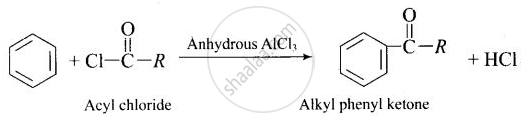
In Friedel-Crafts acylation reactions, the benzene is treated with an acid chloride in presence of anhydrous \[\ce{AlCl3}\]. So, Gattermann-Koch reaction can be considered similar to Friedel-Crafts acylation reaction.

shaalaa.com
  Is there an error in this question or solution?
Chapter 12: Aldehydes, Ketones and Carboxylic Acids - Multiple Choice Questions (Type - I) [Page 173]

APPEARS IN

NCERT Exemplar Chemistry [English] Class 12
Chapter 12 Aldehydes, Ketones and Carboxylic Acids
Multiple Choice Questions (Type - I) | Q 37 | Page 173

RELATED QUESTIONS

Write the product in the following reaction:


Write the chemical equations to illustrate the following name reactions : Rosenmund reduction


Predict the product of the following reaction:


Esters react with DIBAL-H to produce:


The oxidation of toluene to benzoic acid can be done using which of the following reagents.


Name the electrophile produced in the reaction of benzene with benzoyl chloride in the presence of anhydrous \[\ce{AlCl3}\]. Name the reaction also.


Ethylbenzene is generally prepared by acetylation of benzene followed by reduction and not by direct alkylation. Think of a possible reason.


Match the common names given in Column I with the IUPAC names given in Column II.

  Column I
(Common names)
  Column II
(IUPAC names)
(i) Cinnamaldehyde (a) Pentanal
(ii) Acetophenone (b) Prop-2-enal
(iii) Valeraldehyde (c) 4-Methylpent-3-en-2-one
(iv) Acrolein (d) 3-Phenylprop-2-enal
(v) Mesityl oxide (e) 1-Phenylethanone

Match the acids given in Column I with their correct IUPAC names given in Column II.

  Column I
(Acids)
  Column II
(IUPAC names)
(i) Phthalic acid (a) Hexane-1,6-dioic acid
(ii) Oxalic acid (b) Benzene-1,2-dicarboxylic acid
(iii) Succinic acid (c) Pentane-1,5-dioic acid
(iv) Adipic acid (d) Butane-1,4-dioic acid
(v) Glutaric acid (e) Ethane-1,2-dioic acid

An alkene ‘A’ (Mol. formula \[\ce{C5H10}\]) on ozonolysis gives a mixture of two compounds ‘B’ and ‘C’. Compound ‘B’ gives positive Fehling’s test and also forms iodoform on treatment with \[\ce{I2}\] and \[\ce{NaOH}\]. Compound ‘C’ does not give Fehling’s test but forms iodoform. Identify the compounds A, B and C. Write the reaction for ozonolysis and formation of iodoform from B and C.


What is the name of the given reaction of preparation of aldehyde?

\[\ce{C3COCl ->[H2][Pd/BaSO4] CH3CHO + HCl}\]


The reaction 


When 2 – hydroxyl benzoic acid distilled with zinc dust, it give


The intermediate compound ‘X’ in the following chemical reaction is:


The oxidation of toluene to benzaldehyde by chromyl chloride is called ______.


Convert the following:

Benzoic acid to Benzaldehyde.


The reaction of benzene with CO and HCl in the presence of anhydrous AlCl3 gives ______.


Write the name of the reaction, structure and IUPAC name of the product formed when:

CH3CH2CN reacts with stannous chloride in the presence of hydrochloric acid, followed by hydrolysis.


Share
Notifications

Englishहिंदीमराठी


      Forgot password?
Use app×