English
Karnataka Board PUCPUC Science 2nd PUC Class 12

Match the common names given in Column I with the IUPAC names given in Column II. Column I (Common names) Column II (IUPAC names) (i) Cinnamaldehyde (a) Pentanal (ii) Acetophenone (b) - Chemistry

Advertisements
Advertisements

Question

Match the common names given in Column I with the IUPAC names given in Column II.

  Column I
(Common names)
  Column II
(IUPAC names)
(i) Cinnamaldehyde (a) Pentanal
(ii) Acetophenone (b) Prop-2-enal
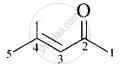
(iii) Valeraldehyde (c) 4-Methylpent-3-en-2-one
(iv) Acrolein (d) 3-Phenylprop-2-enal
(v) Mesityl oxide (e) 1-Phenylethanone
Match the Columns
Advertisements

Solution

  Column I
(Common names)
  Column II
(IUPAC names)
(i) Cinnamaldehyde (d) 3-Phenylprop-2-enal
(ii) Acetophenone (e) 1-Phenylethanone
(iii) Valeraldehyde (a) Pentanal
(iv) Acrolein (b) Prop-2-enal
(v) Mesityl oxide (c) 4-Methylpent-3-en-2-one

Explanation:

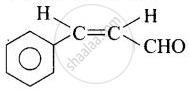
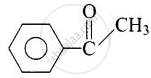
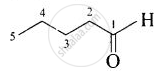
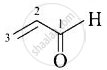
(Common names) Structure (IUPAC names)
(i) Cinnamaldehyde 3-Phenylprop-2-enal
(ii) Acetophenone 1-Phenylethanone
(iii) Valeraldehyde Pentanal
(iv) Acrolein Prop-2-enal
(v) Mesityl oxide 4-Methylpent-3-en-2- one
shaalaa.com
  Is there an error in this question or solution?
Chapter 12: Aldehydes, Ketones and Carboxylic Acids - Multiple Choice Questions (Type - I) [Page 174]

APPEARS IN

NCERT Exemplar Chemistry [English] Class 12
Chapter 12 Aldehydes, Ketones and Carboxylic Acids
Multiple Choice Questions (Type - I) | Q 38 | Page 174

RELATED QUESTIONS

Write the product in the following reaction


Write the product in the following reaction:


Write the chemical equations to illustrate the following name reactions : Rosenmund reduction


Write the reaction involved in the Stephen reduction


When 0.4 g of acetic acid is dissolved in 40 g of benzene, the freezing point of the solution is lowered by 0.45 K. Calculate the degree of association of acetic acid. Acetic acid forms dimer when dissolved in benzene.
(Kf for benzene = 5.12 K kg mol−1, at. wt. C = 12, H = 1, O = 16)


Ozonolysis of alkenes followed by the reaction with zinc dust and water gives ____________ depending on the substitution pattern of the alkene.


Esters react with DIBAL-H to produce:


Aldehydes are prepared by reducing nitriles to corresponding imines with stannous chloride in the presence of hydrochloric acid. This reaction is called:


Name the electrophile produced in the reaction of benzene with benzoyl chloride in the presence of anhydrous \[\ce{AlCl3}\]. Name the reaction also.


Can Gatterman-Koch reaction be considered similar to Friedel Craft’s acylation? Discuss.


Match the acids given in Column I with their correct IUPAC names given in Column II.

  Column I
(Acids)
  Column II
(IUPAC names)
(i) Phthalic acid (a) Hexane-1,6-dioic acid
(ii) Oxalic acid (b) Benzene-1,2-dicarboxylic acid
(iii) Succinic acid (c) Pentane-1,5-dioic acid
(iv) Adipic acid (d) Butane-1,4-dioic acid
(v) Glutaric acid (e) Ethane-1,2-dioic acid

Match the example given in Column I with the name of the reaction in Column II.

  Column I
(Example)
  Column II
(Reaction)
(i) \[\begin{array}{cc}
\phantom{...}\ce{O}\phantom{..............................}\ce{O}\phantom{}\\
\phantom{...}||\phantom{..............................}||\phantom{}\\
\ce{CH3 - C - Cl + H2 ->[Pd - C/BasO4] CH3 - C - H}
\end{array}\]
(a) Friedel Crafts acylation
(ii) (b) HVZ reaction
(iii) (c) Aldol condensation
(iv) \[\begin{array}{cc}
\ce{R - CH2 - COOH ->[Br/Red P] R - CH - COOH}\\
\phantom{.....................}|\\
\phantom{.......................}\ce{Br}
\end{array}\]
(d) Cannizaro’s reaction
(v) \[\ce{CH3 - CN ->[(i) SnCl2/HCl][(ii) H2O/H+] CH3CHO}\] (e) Rosenmund’s reductio
(vi) \[\ce{2CH3CHO ->[NaOH] CH3 - CH = CHCHO}\] (f) Stephen’s reaction

An aromatic compound ‘A’ (Molecular formula \[\ce{C8H8O}\]) gives positive 2, 4-DNP test. It gives a yellow precipitate of compound ‘B’ on treatment with iodine and sodium hydroxide solution. Compound ‘A’ does not give Tollen’s or Fehling’s test. On drastic oxidation with potassium permanganate it forms a carboxylic acid ‘C’ (Molecular formula \[\ce{C7H6O2}\]), which is also formed along with the yellow compound in the above reaction. Identify A, B and C and write all the reactions involved.


When 2 – hydroxyl benzoic acid distilled with zinc dust, it give


The general formula CnH2NO2 could be for open chain


Aldehydes are the first oxidation products of ______.


Convert the following:

Benzoic acid to Benzaldehyde.


Predict the reagent for carrying out the following transformations:

Benzoyl chloride to Benzaldehyde


Share
Notifications

Englishहिंदीमराठी


      Forgot password?
Use app×