Advertisements
Advertisements
प्रश्न
Match the common names given in Column I with the IUPAC names given in Column II.
| Column I (Common names) |
Column II (IUPAC names) |
||
| (i) | Cinnamaldehyde | (a) | Pentanal |
| (ii) | Acetophenone | (b) | Prop-2-enal |
| (iii) | Valeraldehyde | (c) | 4-Methylpent-3-en-2-one |
| (iv) | Acrolein | (d) | 3-Phenylprop-2-enal |
| (v) | Mesityl oxide | (e) | 1-Phenylethanone |
Advertisements
उत्तर
| Column I (Common names) |
Column II (IUPAC names) |
||
| (i) | Cinnamaldehyde | (d) | 3-Phenylprop-2-enal |
| (ii) | Acetophenone | (e) | 1-Phenylethanone |
| (iii) | Valeraldehyde | (a) | Pentanal |
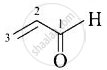
| (iv) | Acrolein | (b) | Prop-2-enal |
| (v) | Mesityl oxide | (c) | 4-Methylpent-3-en-2-one |
Explanation:
| (Common names) | Structure | (IUPAC names) |
| (i) Cinnamaldehyde | ![]() |
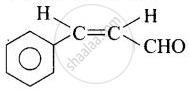
3-Phenylprop-2-enal |
| (ii) Acetophenone | ![]() |
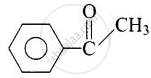
1-Phenylethanone |
| (iii) Valeraldehyde | ![]() |
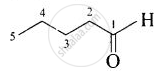
Pentanal |
| (iv) Acrolein | ![]() |
Prop-2-enal |
| (v) Mesityl oxide | ![]() |
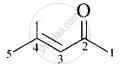
4-Methylpent-3-en-2- one |
APPEARS IN
संबंधित प्रश्न
Predict the product of the following reaction:

How will you prepare the given compound from benzene? You may use any inorganic reagent and any organic reagent having not more than one carbon atom.
p-Nitrobenzaldehyde
Write the reaction involved in the Stephen reduction
When 0.4 g of acetic acid is dissolved in 40 g of benzene, the freezing point of the solution is lowered by 0.45 K. Calculate the degree of association of acetic acid. Acetic acid forms dimer when dissolved in benzene.
(Kf for benzene = 5.12 K kg mol−1, at. wt. C = 12, H = 1, O = 16)
The oxidation of toluene to benzoic acid can be stopped at the aldehyde stage to give benzaldehyde. The reagent used for the purpose is one of the following.
The oxidation of toluene to benzoic acid can be done using which of the following reagents.
Name the electrophile produced in the reaction of benzene with benzoyl chloride in the presence of anhydrous \[\ce{AlCl3}\]. Name the reaction also.
Ethylbenzene is generally prepared by acetylation of benzene followed by reduction and not by direct alkylation. Think of a possible reason.
Match the example given in Column I with the name of the reaction in Column II.
| Column I (Example) |
Column II (Reaction) |
||
| (i) | \[\begin{array}{cc} \phantom{...}\ce{O}\phantom{..............................}\ce{O}\phantom{}\\ \phantom{...}||\phantom{..............................}||\phantom{}\\ \ce{CH3 - C - Cl + H2 ->[Pd - C/BasO4] CH3 - C - H} \end{array}\] |
(a) | Friedel Crafts acylation |
| (ii) | ![]() |
(b) | HVZ reaction |
| (iii) | ![]() |
(c) | Aldol condensation |
| (iv) | \[\begin{array}{cc} \ce{R - CH2 - COOH ->[Br/Red P] R - CH - COOH}\\ \phantom{.....................}|\\ \phantom{.......................}\ce{Br} \end{array}\] |
(d) | Cannizaro’s reaction |
| (v) | \[\ce{CH3 - CN ->[(i) SnCl2/HCl][(ii) H2O/H+] CH3CHO}\] | (e) | Rosenmund’s reductio |
| (vi) | \[\ce{2CH3CHO ->[NaOH] CH3 - CH = CHCHO}\] | (f) | Stephen’s reaction |
An alkene ‘A’ (Mol. formula \[\ce{C5H10}\]) on ozonolysis gives a mixture of two compounds ‘B’ and ‘C’. Compound ‘B’ gives positive Fehling’s test and also forms iodoform on treatment with \[\ce{I2}\] and \[\ce{NaOH}\]. Compound ‘C’ does not give Fehling’s test but forms iodoform. Identify the compounds A, B and C. Write the reaction for ozonolysis and formation of iodoform from B and C.
The reaction

The strongest base among the following
When 2 – hydroxyl benzoic acid distilled with zinc dust, it give
The general formula CnH2NO2 could be for open chain
The reagent in friedel - craft reaction is:
The intermediate compound ‘X’ in the following chemical reaction is:

Explain the following reactions:
Stephan reaction
The reaction of benzene with CO and HCl in the presence of anhydrous AlCl3 gives ______.
Account for the following:
N-ethylbenzene sulphonyl amide is soluble in alkali.