हिंदी
कर्नाटक बोर्ड पी.यू.सी.पीयूसी विज्ञान 2nd PUC Class 12

Match the acids given in Column I with their correct IUPAC names given in Column II. Column I (Acids) Column II (IUPAC names) (i) Phthalic acid (a) Hexane-1,6-dioic acid (ii) Oxalic acid (b) - Chemistry

Advertisements
Advertisements

प्रश्न

Match the acids given in Column I with their correct IUPAC names given in Column II.

  Column I
(Acids)
  Column II
(IUPAC names)
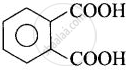
(i) Phthalic acid (a) Hexane-1,6-dioic acid
(ii) Oxalic acid (b) Benzene-1,2-dicarboxylic acid
(iii) Succinic acid (c) Pentane-1,5-dioic acid
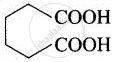
(iv) Adipic acid (d) Butane-1,4-dioic acid
(v) Glutaric acid (e) Ethane-1,2-dioic acid
जोड़ियाँ मिलाइएँ
Advertisements

उत्तर

  Column I
(Acids)
  Column II
(IUPAC names)
(i) Phthalic acid (b) Benzene-1,2-dicarboxylic acid
(ii) Oxalic acid (e) Ethane-1,2-dioic acid
(iii) Succinic acid (d) Butane-1,4-dioic acid
(iv) Adipic acid (a) Hexane-1,6-dioic acid
(v) Glutaric acid (c) Pentane-1,5-dioic acid

Explanation:

Acids IUPAC names Structure
(i) Phthalic acid Benzene-1,2-dicarboxylic acid
(ii) Oxalic acid Ethane-1,2-dioic acid \[\begin{array}{cc}
\ce{COOH}\\
|\phantom{......}\\
\ce{COOH}
\end{array}\]
(iii) Succinic acid Butane-1,4-dioic acid
(iv) Adipic acid Hexane-1,6-dioic acid
(v) Glutaric acid Pentane-1,5-dioic acid
shaalaa.com
  क्या इस प्रश्न या उत्तर में कोई त्रुटि है?
अध्याय 12: Aldehydes, Ketones and Carboxylic Acids - Multiple Choice Questions (Type - I) [पृष्ठ १७४]

APPEARS IN

एनसीईआरटी एक्झांप्लर Chemistry [English] Class 12
अध्याय 12 Aldehydes, Ketones and Carboxylic Acids
Multiple Choice Questions (Type - I) | Q 39 | पृष्ठ १७४

संबंधित प्रश्न

Write the product in the following reaction


Write the product in the following reaction:


How will you bring about the following conversion?

Benzoyl chloride to benzaldehyde.


Write the reaction involved in the Stephen reduction


When 0.4 g of acetic acid is dissolved in 40 g of benzene, the freezing point of the solution is lowered by 0.45 K. Calculate the degree of association of acetic acid. Acetic acid forms dimer when dissolved in benzene.
(Kf for benzene = 5.12 K kg mol−1, at. wt. C = 12, H = 1, O = 16)


Ozonolysis of alkenes followed by the reaction with zinc dust and water gives ____________ depending on the substitution pattern of the alkene.


The oxidation of toluene to benzoic acid can be stopped at the aldehyde stage to give benzaldehyde. The reagent used for the purpose is one of the following.


The oxidation of toluene to benzoic acid can be done using which of the following reagents.


Name the electrophile produced in the reaction of benzene with benzoyl chloride in the presence of anhydrous \[\ce{AlCl3}\]. Name the reaction also.


Match the common names given in Column I with the IUPAC names given in Column II.

  Column I
(Common names)
  Column II
(IUPAC names)
(i) Cinnamaldehyde (a) Pentanal
(ii) Acetophenone (b) Prop-2-enal
(iii) Valeraldehyde (c) 4-Methylpent-3-en-2-one
(iv) Acrolein (d) 3-Phenylprop-2-enal
(v) Mesityl oxide (e) 1-Phenylethanone

Match the example given in Column I with the name of the reaction in Column II.

  Column I
(Example)
  Column II
(Reaction)
(i) \[\begin{array}{cc}
\phantom{...}\ce{O}\phantom{..............................}\ce{O}\phantom{}\\
\phantom{...}||\phantom{..............................}||\phantom{}\\
\ce{CH3 - C - Cl + H2 ->[Pd - C/BasO4] CH3 - C - H}
\end{array}\]
(a) Friedel Crafts acylation
(ii) (b) HVZ reaction
(iii) (c) Aldol condensation
(iv) \[\begin{array}{cc}
\ce{R - CH2 - COOH ->[Br/Red P] R - CH - COOH}\\
\phantom{.....................}|\\
\phantom{.......................}\ce{Br}
\end{array}\]
(d) Cannizaro’s reaction
(v) \[\ce{CH3 - CN ->[(i) SnCl2/HCl][(ii) H2O/H+] CH3CHO}\] (e) Rosenmund’s reductio
(vi) \[\ce{2CH3CHO ->[NaOH] CH3 - CH = CHCHO}\] (f) Stephen’s reaction

An alkene ‘A’ (Mol. formula \[\ce{C5H10}\]) on ozonolysis gives a mixture of two compounds ‘B’ and ‘C’. Compound ‘B’ gives positive Fehling’s test and also forms iodoform on treatment with \[\ce{I2}\] and \[\ce{NaOH}\]. Compound ‘C’ does not give Fehling’s test but forms iodoform. Identify the compounds A, B and C. Write the reaction for ozonolysis and formation of iodoform from B and C.


An aromatic compound ‘A’ (Molecular formula \[\ce{C8H8O}\]) gives positive 2, 4-DNP test. It gives a yellow precipitate of compound ‘B’ on treatment with iodine and sodium hydroxide solution. Compound ‘A’ does not give Tollen’s or Fehling’s test. On drastic oxidation with potassium permanganate it forms a carboxylic acid ‘C’ (Molecular formula \[\ce{C7H6O2}\]), which is also formed along with the yellow compound in the above reaction. Identify A, B and C and write all the reactions involved.


\[\begin{array}{cc}
\ce{CH3 - CH2 - CH - CH3}\\
\phantom{.....}|\\
\phantom{......}\ce{Cl}
\end{array}\]  obtained by chlorination of n-butane, will be


Aldehydes are the first oxidation products of ______.


The intermediate compound ‘X’ in the following chemical reaction is:


An organic compound with molecular formula \[\ce{C7H7NO2}\] exists in three isomeric forms, the isomer ‘A’ has the highest melting point of the three. ‘A’ on reduction gives compound ‘B’ with molecular formula \[\ce{C7H9N}\]. ‘B’ on treatment with \[\ce{NaNO2/HCl}\] at 0-5° C to form compound ‘C’. On treating C with \[\ce{H3PO2}\], it gets converted to D with formula \[\ce{C7H8}\], which on further reaction with \[\ce{CrO2Cl2}\] followed by hydrolysis forms ‘E’ \[\ce{C7H6O}\]. Write the structure of compounds A to E. Write the chemical equations involved.


Account for the following:

Reduction of nitrobenzene using Fe and HCl is preferred over Sn and HCl.


Write the name of the reaction, structure and IUPAC name of the product formed when:

CH3CH2CN reacts with stannous chloride in the presence of hydrochloric acid, followed by hydrolysis.


Share
Notifications

Englishहिंदीमराठी


      Forgot password?
Use app×