Advertisements
Advertisements
Question
Match the acids given in Column I with their correct IUPAC names given in Column II.
| Column I (Acids) |
Column II (IUPAC names) |
||
| (i) | Phthalic acid | (a) | Hexane-1,6-dioic acid |
| (ii) | Oxalic acid | (b) | Benzene-1,2-dicarboxylic acid |
| (iii) | Succinic acid | (c) | Pentane-1,5-dioic acid |
| (iv) | Adipic acid | (d) | Butane-1,4-dioic acid |
| (v) | Glutaric acid | (e) | Ethane-1,2-dioic acid |
Advertisements
Solution
| Column I (Acids) |
Column II (IUPAC names) |
||
| (i) | Phthalic acid | (b) | Benzene-1,2-dicarboxylic acid |
| (ii) | Oxalic acid | (e) | Ethane-1,2-dioic acid |
| (iii) | Succinic acid | (d) | Butane-1,4-dioic acid |
| (iv) | Adipic acid | (a) | Hexane-1,6-dioic acid |
| (v) | Glutaric acid | (c) | Pentane-1,5-dioic acid |
Explanation:
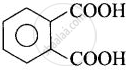
| Acids | IUPAC names | Structure |
| (i) Phthalic acid | Benzene-1,2-dicarboxylic acid | ![]() |
| (ii) Oxalic acid | Ethane-1,2-dioic acid | \[\begin{array}{cc} \ce{COOH}\\ |\phantom{......}\\ \ce{COOH} \end{array}\] |
| (iii) Succinic acid | Butane-1,4-dioic acid | ![]() |
| (iv) Adipic acid | Hexane-1,6-dioic acid | ![]() |
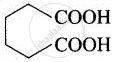
| (v) Glutaric acid | Pentane-1,5-dioic acid | ![]() |
APPEARS IN
RELATED QUESTIONS
How will you prepare the given compound from benzene? You may use any inorganic reagent and any organic reagent having not more than one carbon atom.
p-Nitrobenzaldehyde
Name the electrophile produced in the reaction of benzene with benzoyl chloride in the presence of anhydrous \[\ce{AlCl3}\]. Name the reaction also.
Ethylbenzene is generally prepared by acetylation of benzene followed by reduction and not by direct alkylation. Think of a possible reason.
Can Gatterman-Koch reaction be considered similar to Friedel Craft’s acylation? Discuss.
Match the common names given in Column I with the IUPAC names given in Column II.
| Column I (Common names) |
Column II (IUPAC names) |
||
| (i) | Cinnamaldehyde | (a) | Pentanal |
| (ii) | Acetophenone | (b) | Prop-2-enal |
| (iii) | Valeraldehyde | (c) | 4-Methylpent-3-en-2-one |
| (iv) | Acrolein | (d) | 3-Phenylprop-2-enal |
| (v) | Mesityl oxide | (e) | 1-Phenylethanone |
An aromatic compound ‘A’ (Molecular formula \[\ce{C8H8O}\]) gives positive 2, 4-DNP test. It gives a yellow precipitate of compound ‘B’ on treatment with iodine and sodium hydroxide solution. Compound ‘A’ does not give Tollen’s or Fehling’s test. On drastic oxidation with potassium permanganate it forms a carboxylic acid ‘C’ (Molecular formula \[\ce{C7H6O2}\]), which is also formed along with the yellow compound in the above reaction. Identify A, B and C and write all the reactions involved.
What is the name of the given reaction of preparation of aldehyde?
\[\ce{C3COCl ->[H2][Pd/BaSO4] CH3CHO + HCl}\]
When 2 – hydroxyl benzoic acid distilled with zinc dust, it give
Aldehydes are the first oxidation products of ______.
The reagent in friedel - craft reaction is:
Convert the following:
Benzoic acid to Benzaldehyde.
Explain the following reactions:
Stephan reaction
Predict the reagent for carrying out the following transformations:
Benzoyl chloride to Benzaldehyde
Reagent used to convert allyl alcohol to acrolein is ______.
Assertion (A): Strong oxidising agents oxidise toluene and its derivatives to benzoic acids.
Reason (R): It is possible to stop the oxidation of toluene at the aldehyde stage with suitable reagents.
Select the most appropriate answer from the options given below:
An organic compound with molecular formula \[\ce{C7H7NO2}\] exists in three isomeric forms, the isomer ‘A’ has the highest melting point of the three. ‘A’ on reduction gives compound ‘B’ with molecular formula \[\ce{C7H9N}\]. ‘B’ on treatment with \[\ce{NaNO2/HCl}\] at 0-5° C to form compound ‘C’. On treating C with \[\ce{H3PO2}\], it gets converted to D with formula \[\ce{C7H8}\], which on further reaction with \[\ce{CrO2Cl2}\] followed by hydrolysis forms ‘E’ \[\ce{C7H6O}\]. Write the structure of compounds A to E. Write the chemical equations involved.
Account for the following:
N-ethylbenzene sulphonyl amide is soluble in alkali.


