हिंदी
कर्नाटक बोर्ड पी.यू.सी.पीयूसी विज्ञान 2nd PUC Class 12

Can Gatterman-Koch reaction be considered similar to Friedel Craft’s acylation? Discuss. - Chemistry

Advertisements
Advertisements

प्रश्न

Can Gatterman-Koch reaction be considered similar to Friedel Craft’s acylation? Discuss.

टिप्पणी लिखिए
Advertisements

उत्तर

Gattermann-Koch reaction is formylation (introduction of-CHO group) to the benzene nucleus. Friedel-Crafts acylation reaction is introduction of RCO-group in the benzene ring.

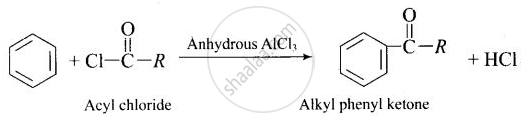
In Friedel-Crafts acylation reactions, the benzene is treated with an acid chloride in presence of anhydrous \[\ce{AlCl3}\]. So, Gattermann-Koch reaction can be considered similar to Friedel-Crafts acylation reaction.

shaalaa.com
  क्या इस प्रश्न या उत्तर में कोई त्रुटि है?
अध्याय 12: Aldehydes, Ketones and Carboxylic Acids - Multiple Choice Questions (Type - I) [पृष्ठ १७३]

APPEARS IN

एनसीईआरटी एक्झांप्लर Chemistry [English] Class 12
अध्याय 12 Aldehydes, Ketones and Carboxylic Acids
Multiple Choice Questions (Type - I) | Q 37 | पृष्ठ १७३

संबंधित प्रश्न

Write the product in the following reaction


Write the chemical equations to illustrate the following name reactions : Rosenmund reduction


How will you prepare the given compound from benzene? You may use any inorganic reagent and any organic reagent having not more than one carbon atom.

p-Nitrobenzaldehyde


Esters react with DIBAL-H to produce:


Aldehydes are produced on reduction of the following by DIBAL-H:


Name the electrophile produced in the reaction of benzene with benzoyl chloride in the presence of anhydrous \[\ce{AlCl3}\]. Name the reaction also.


Ethylbenzene is generally prepared by acetylation of benzene followed by reduction and not by direct alkylation. Think of a possible reason.


Match the acids given in Column I with their correct IUPAC names given in Column II.

  Column I
(Acids)
  Column II
(IUPAC names)
(i) Phthalic acid (a) Hexane-1,6-dioic acid
(ii) Oxalic acid (b) Benzene-1,2-dicarboxylic acid
(iii) Succinic acid (c) Pentane-1,5-dioic acid
(iv) Adipic acid (d) Butane-1,4-dioic acid
(v) Glutaric acid (e) Ethane-1,2-dioic acid

An aromatic compound ‘A’ (Molecular formula \[\ce{C8H8O}\]) gives positive 2, 4-DNP test. It gives a yellow precipitate of compound ‘B’ on treatment with iodine and sodium hydroxide solution. Compound ‘A’ does not give Tollen’s or Fehling’s test. On drastic oxidation with potassium permanganate it forms a carboxylic acid ‘C’ (Molecular formula \[\ce{C7H6O2}\]), which is also formed along with the yellow compound in the above reaction. Identify A, B and C and write all the reactions involved.


\[\begin{array}{cc}
\ce{CH3 - CH2 - CH - CH3}\\
\phantom{.....}|\\
\phantom{......}\ce{Cl}
\end{array}\]  obtained by chlorination of n-butane, will be


The strongest base among the following


The general formula CnH2NO2 could be for open chain


Aldehydes are the first oxidation products of ______.


The intermediate compound ‘X’ in the following chemical reaction is:


Explain the following reactions:

Stephan reaction


Predict the reagent for carrying out the following transformations:

Benzoyl chloride to Benzaldehyde


The reaction of benzene with CO and HCl in the presence of anhydrous AlCl3 gives ______.


Account for the following:

N-ethylbenzene sulphonyl amide is soluble in alkali.


Share
Notifications

Englishहिंदीमराठी


      Forgot password?
Use app×