Advertisements
Advertisements
प्रश्न
Can Gatterman-Koch reaction be considered similar to Friedel Craft’s acylation? Discuss.
Advertisements
उत्तर
Gattermann-Koch reaction is formylation (introduction of-CHO group) to the benzene nucleus. Friedel-Crafts acylation reaction is introduction of RCO-group in the benzene ring.

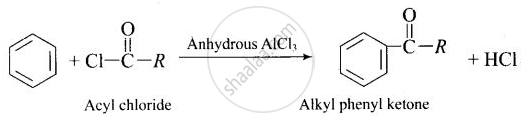
In Friedel-Crafts acylation reactions, the benzene is treated with an acid chloride in presence of anhydrous \[\ce{AlCl3}\]. So, Gattermann-Koch reaction can be considered similar to Friedel-Crafts acylation reaction.
APPEARS IN
संबंधित प्रश्न
Write the product in the following reaction

Predict the product of the following reaction:

How will you prepare the given compound from benzene? You may use any inorganic reagent and any organic reagent having not more than one carbon atom.
p-Nitrobenzaldehyde
Write the reaction involved in the Stephen reduction
When 0.4 g of acetic acid is dissolved in 40 g of benzene, the freezing point of the solution is lowered by 0.45 K. Calculate the degree of association of acetic acid. Acetic acid forms dimer when dissolved in benzene.
(Kf for benzene = 5.12 K kg mol−1, at. wt. C = 12, H = 1, O = 16)
Esters react with DIBAL-H to produce:
Aldehydes are prepared by reducing nitriles to corresponding imines with stannous chloride in the presence of hydrochloric acid. This reaction is called:
The oxidation of toluene to benzoic acid can be done using which of the following reagents.
In the chromyl chloride test, the final step results in the formation of a yellow precipitate of the following:
The reaction

The strongest base among the following
The number of chiral carbon in glucose is:-
The general formula CnH2NO2 could be for open chain
The reagent in friedel - craft reaction is:
The intermediate compound ‘X’ in the following chemical reaction is:

The oxidation of toluene to benzaldehyde by chromyl chloride is called ______.
Reagent used to convert allyl alcohol to acrolein is ______.
An organic compound with molecular formula \[\ce{C7H7NO2}\] exists in three isomeric forms, the isomer ‘A’ has the highest melting point of the three. ‘A’ on reduction gives compound ‘B’ with molecular formula \[\ce{C7H9N}\]. ‘B’ on treatment with \[\ce{NaNO2/HCl}\] at 0-5° C to form compound ‘C’. On treating C with \[\ce{H3PO2}\], it gets converted to D with formula \[\ce{C7H8}\], which on further reaction with \[\ce{CrO2Cl2}\] followed by hydrolysis forms ‘E’ \[\ce{C7H6O}\]. Write the structure of compounds A to E. Write the chemical equations involved.
